

A THC gummy that once felt exactly right may eventually feel softer, shorter, or almost unnoticeable. That does not automatically mean the product changed. When THC exposure becomes frequent, the body can become less responsive to the same signal. That adaptation is called THC tolerance.
Tolerance is neither a character flaw nor proof that someone has an addiction. It is a normal biological response to repeated exposure. It can also be frustrating and expensive when the answer becomes stronger products, larger amounts, or more frequent use – especially when those changes happen without a plan.
The good news is that THC tolerance is generally reversible. The less simple part is timing. Human brain-imaging research shows that cannabinoid receptor availability can begin recovering quickly after THC stops, yet there is no scientifically validated number of days that guarantees a complete reset for every person.
| THE SHORT ANSWER A brief pause may begin lowering THC tolerance, while a longer pause gives the endocannabinoid system more time to recover. Two days is evidence of early biological change – not proof of a full reset. Roughly four weeks is the strongest human research benchmark for more complete CB1 receptor normalization in chronic daily users, but lighter users may notice a meaningful change sooner. |
In this guide, we will explain what THC tolerance actually is, why Delta-8 and Delta-9 tolerance can overlap, what the human studies do and do not show, and how adults can return to gummies more thoughtfully after a break.
What Is THC Tolerance?
THC tolerance means the same amount produces a smaller response than it once did, or a larger amount is needed to produce a similar response. The change may involve the strength of the experience, its duration, or particular effects such as relaxation, euphoria, appetite, anxiety, memory, or coordination.
Tolerance is not the only reason a gummy can feel inconsistent. A delayed meal, individual metabolism, digestive absorption, medication interactions, product storage, inaccurate labeling, or simply taking more before the first serving peaks can all change an edible experience.
If the problem is that gummies have never worked reliably – rather than gradually working less over time – begin with Why Don’t THC Gummies Work for Me? Metabolism, Tolerance & Other Reasons. That guide separates tolerance from absorption, timing, and product-quality issues.
Tolerance is not the same as dependence
Tolerance describes reduced response. Physical dependence means the body has adapted enough that stopping or sharply reducing frequent use can produce withdrawal symptoms. Cannabis use disorder describes a broader pattern in which use becomes difficult to control or continues despite meaningful harm. These concepts can overlap, but none of them should be treated as interchangeable.
Why THC Tolerance Builds: The CB1 Receptor Story

Delta-9 THC produces many of its familiar intoxicating effects by activating cannabinoid type 1, or CB1, receptors throughout the brain and nervous system. Delta-8 THC reaches the same receptor system, although its potency and metabolism differ.
When CB1 receptors are activated repeatedly, the nervous system tries to maintain balance. Receptors may become temporarily less responsive, a process called desensitization, and the number of receptors readily available for signaling may decrease, often described as downregulation. The receptors are not burned out or permanently damaged. The system is turning down its sensitivity to a signal it receives often.
That is why tolerance is primarily pharmacodynamic: the body is changing its response to THC. It is not simply a matter of THC remaining stored in body fat, the liver forgetting how to process a gummy, or needing a juice cleanse to remove something from the bloodstream.
THC tolerance is the body’s volume control turning down a repeated signal – not the product suddenly becoming invisible.
What Human Brain-Imaging Studies Actually Show
The four-week study
A 2012 positron-emission tomography study compared 30 chronic daily cannabis smokers with 28 control participants. The daily users showed lower CB1 receptor availability in several cortical regions. Fourteen participants completed a second scan after about four weeks of continuously monitored abstinence, and CB1 receptor availability returned to levels comparable with controls.
Read the 2012 human CB1 receptor study.
The two-day and 28-day study
A second PET study published in 2016 followed 11 cannabis-dependent men and compared them with 19 healthy controls. At baseline, CB1 receptor availability was about 15 percent lower in the cannabis group. After two days of monitored abstinence, the group difference was no longer statistically evident; after 28 days, there was still no significant difference.
Read the 2016 rapid-recovery study.
What those results mean – and what they do not
Together, the studies show that CB1 receptor adaptation can reverse and may begin reversing surprisingly quickly. They do not prove that every person will feel completely reset after 48 hours. The smaller study included only men with cannabis dependence, and both studies focused on chronic cannabis smokers rather than occasional gummy users.
Most importantly, receptor availability is a biological marker. It is not a direct meter for how strong a particular gummy will feel. A person’s subjective experience also depends on prior amount, frequency, sleep, food, stress, formulation, route, and individual biology.
THC Tolerance Is Not All-or-Nothing
The body may develop tolerance to some THC effects faster or more completely than others. In a controlled study comparing 30 frequent cannabis users with 22 controls, frequent users showed smaller responses to several cognitive, anxiety-related, perceptual, and hormonal effects of intravenous Delta-9 THC. Their ratings of euphoria, however, were not reduced in the same way.
That effect-by-effect pattern is described in the 2008 controlled THC study.
This matters because feeling less intoxicated does not guarantee that every form of impairment has disappeared. High tolerance should never be treated as permission to drive, operate machinery, or combine THC with alcohol. In a controlled study of heavy cannabis users, alcohol still impaired performance and the THC-alcohol combination worsened divided attention more than alcohol alone.
See the THC and alcohol performance study.
Why THC Gummies Can Push Tolerance Up
Edibles do not create a completely separate kind of tolerance. Oral THC is processed differently than inhaled THC and produces the active metabolite 11-hydroxy-THC, which can make a gummy feel longer-lasting or more intense. The resulting effects still rely heavily on CB1 signaling, so repeated edible exposure can contribute to the same adaptation.
The biggest tolerance drivers are usually straightforward:
- Frequency: using THC on most days gives the receptor system fewer low-exposure periods.
- Total exposure: larger per-session amounts and multiple sessions in one day create more repeated CB1 activation.
- Potency escalation: moving to stronger products whenever effects soften can keep pushing the baseline upward.
- Early redosing: adding another gummy before the first serving has fully developed can turn an intended amount into a much larger session.
- Duration of the pattern: months or years of near-daily use may produce a different reset experience than a short stretch of occasional use.
For edible onset, peak, and duration, see How Long Do THC Gummies Last? The delayed onset is one reason measured servings and patience matter.
Do Delta-8 and Delta-9 Share Tolerance?
Delta-8 THC and Delta-9 THC are not identical, but both produce intoxicating effects largely through CB1 receptors. A 2025 double-blind oral study in adults with no past-month cannabinoid exposure found that Delta-8 produced dose-dependent psychoactive effects similar in character to Delta-9, with lower potency at the same milligram amount. That was an acute comparison study, not a tolerance trial.
Read the 2025 oral Delta-8 versus Delta-9 study.
Repeated Delta-8 exposure has produced tolerance and evidence of reduced CB1 function in mice. Direct human research mapping cross-tolerance between commercial Delta-8 and Delta-9 gummies is still limited, so the science does not justify an exact conversion rule.
See the 2022 repeated Delta-8 animal study.
| PRACTICAL TAKEAWAY Switching from Delta-9 to Delta-8 – or from one intoxicating cannabinoid to another – may change the feel and potency, but it is not a dependable tolerance reset. If the goal is to give CB1 signaling a genuine break, rotating products that activate the same system works against that goal. |
For the broader potency, effect, and chemistry comparison, read Delta-8 vs Delta-9: What’s the Real Difference?.
How Long Should a THC Tolerance Break Be?
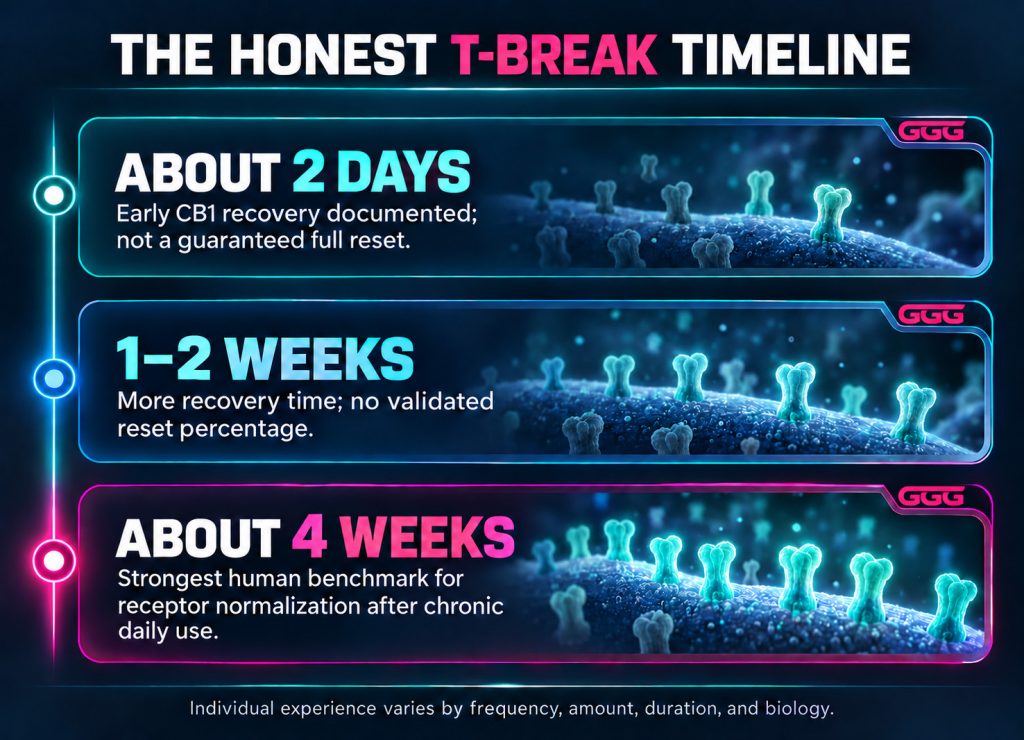
| NO UNIVERSAL RESET CLOCK There is no clinical formula proving that every light user needs two days, every regular user needs two weeks, or every daily user needs 28 days. The ranges below are evidence-informed landmarks, not guarantees. |
About 48 hours: early recovery, not a promised reset
The 2016 PET study found that lower CB1 receptor availability in cannabis-dependent men was no longer statistically different from controls after two days. That is meaningful evidence that recovery begins quickly. It does not tell us that a person’s former edible amount will feel brand new on day three.
One to two weeks: more recovery time, but no validated percentage
A one- or two-week THC tolerance break gives the system substantially more low-exposure time than a weekend pause. Many adults choose this as a practical middle ground. Research has not established a reliable claim such as a 50-percent or 80-percent reset at either point, so individual tracking matters more than an internet chart.
Around four weeks: the strongest human benchmark for chronic daily use
The clearest human evidence for receptor normalization comes from roughly four weeks of monitored abstinence in chronic daily users. That makes 28 days a reasonable research benchmark for someone seeking a more complete reset after sustained daily exposure – not a mandatory minimum for every adult.
What about longer breaks?
A longer break may support other goals, including changing habits or evaluating whether THC is still serving the intended purpose. There is no good evidence that everyone needs a 60- or 90-day break solely to make CB1 receptors functional again. Receptor recovery, metabolite clearance, a negative drug test, and changing a daily routine are four different goals with different timelines.
How to Take a THC Tolerance Break With a Plan
A tolerance break works better when the goal is defined before day one. The goal does not have to be quitting forever. It might be restoring sensitivity, lowering the amount used, reducing spending, checking whether nightly use has become automatic, or making future experiences more predictable.
- Choose the goal and length. Write down why you are pausing and the date you plan to reassess.
- Choose a full pause or a deliberate reduction. A full pause gives the clearest break from intoxicating cannabinoids. Reducing use days, sessions, or amount may still lower total exposure when a full pause is not realistic, but it is not the same biological test.
- Remove autopilot cues. Put gummies out of sight, change the usual evening routine, and avoid buying a stronger product simply because the current amount feels softer.
- Protect sleep and meals. Keep a consistent bedtime, plan simple meals, move during the day, and expect the first several nights to feel different if THC has been part of a nightly routine.
- Track the experience. Note sleep, appetite, mood, cravings, energy, and the original reason for using THC. This turns the break into useful personal data.
- Skip detox promises. Water, supplements, sweating, and cleanses have not been shown to instantly restore CB1 sensitivity. Hydration and regular meals can support comfort, but they do not replace time at lower exposure.
What Can Happen During a Break?
Someone who uses THC occasionally may notice little beyond a change in routine. After heavy daily use, stopping abruptly can produce cannabis withdrawal symptoms such as irritability, anxiety, restlessness, sleep difficulty or vivid dreams, decreased appetite, stomach discomfort, and cravings.
In a 50-day outpatient study involving 18 current users and 12 former users, symptoms commonly began during days 1 to 3, peaked during days 2 to 6, and most lasted about 4 to 14 days. That small study describes a pattern, not a prediction for every person.
Read the cannabis withdrawal time-course study.
Tolerance and withdrawal should be discussed honestly without treating every regular consumer as disordered. If symptoms become severe, safety feels uncertain, or reducing use repeatedly feels impossible despite real harm, professional support is appropriate.
Returning to THC After a Tolerance Break

The most important part of a reset happens after the break. Returning immediately to the former amount can erase the practical benefit and may produce a much stronger experience than expected because tolerance has fallen.
- Choose a clearly labeled, batch-tested product so the amount per gummy is known.
- Return with a smaller labeled amount than the amount used before the break rather than assuming the old baseline still applies.
- Allow the full edible onset window before considering more. Do not stack servings because the first hour feels quiet.
- Avoid mixing THC with alcohol or other intoxicants, and do not drive or operate machinery.
- Decide in advance how many use days or sessions fit the goal. Planned gaps are easier to maintain than waiting until tolerance is high again.
- Track the smallest amount that produces the intended experience. The target is consistency, not the highest possible tolerance.
Use the THC Gummies Dosage Guide: Delta-8 vs Delta-9 alongside the timing guide before returning to edibles.
Product reliability also matters. Why Premium THC Gummies Matter explains potency verification, formulation consistency, and batch testing.
Can You Lower THC Tolerance Without a Full Break?
A complete pause is the clearest way to remove repeated THC signaling, but it is not the only way to regain control. Lowering total exposure may slow tolerance growth or allow some sensitivity to return.
- Use THC on fewer days rather than automatically every day.
- Limit repeated sessions within the same day.
- Choose a lower-intensity product instead of escalating potency.
- Leave more time between sessions and avoid chasing a specific feeling.
- Reassess the goal: relaxation, sleep, social enjoyment, or another desired experience may not require maximum intensity.
No human trial has established one perfect maintenance schedule. The most useful plan is the one that keeps the experience predictable and prevents the amount from drifting upward unnoticed.
THC Tolerance vs Dependence vs Cannabis Use Disorder
Tolerance
The same amount produces less response, or more is needed for a similar response. Tolerance by itself does not diagnose a disorder.
Physical dependence
The body has adapted to frequent exposure and may produce withdrawal symptoms when use stops or falls sharply. Dependence can occur without compulsive or harmful behavior.
Cannabis use disorder
Use becomes difficult to control or continues despite meaningful problems in health, responsibilities, relationships, or safety. Tolerance can be one feature, but the diagnosis depends on a broader pattern.
This distinction keeps the conversation factual. A person can recognize tolerance and make a thoughtful adjustment without shame. They can also recognize when the problem has moved beyond tolerance and deserves more support.
THC Tolerance FAQ
Will a two-day THC tolerance break do anything?
It can. Human imaging research shows that CB1 receptor availability may begin rebounding rapidly, with group differences no longer evident after two days in one small study. That does not guarantee a complete subjective reset.
Is seven days enough to reset THC tolerance?
Seven days provides more recovery time than 48 hours and may produce a noticeable change for some people. Science has not validated seven days as a universal complete reset.
Does switching from Delta-9 to Delta-8 reset tolerance?
Not reliably. Both cannabinoids engage CB1 receptors, and repeated Delta-8 exposure has produced tolerance in animal research. Switching may change potency or feel without giving the receptor system a true break.
Does CBD reset THC tolerance?
There is no good human evidence that CBD speeds a THC tolerance reset. CBD does not act like intoxicating THC at CB1 receptors, but it should not be marketed as a receptor-reset supplement. A full-spectrum CBD product may also contain trace THC.
Will changing strains or terpenes reset tolerance?
A different cannabinoid and terpene profile may change the subjective character of an experience. It does not prove that CB1 sensitivity has reset while THC exposure continues.
Is a high THC tolerance safer?
No. Tolerance may blunt some felt effects, but it does not guarantee protection from impaired attention, poor decisions, next-day effects, medication interactions, or the added impairment of alcohol.
Does a tolerance break guarantee a negative drug test?
No. Receptor recovery and metabolite detection are separate processes. A person may feel a lower tolerance while THC metabolites remain detectable, especially after frequent use.
The Bottom Line
THC tolerance is a real and generally reversible adaptation. Repeated THC exposure can reduce CB1 receptor responsiveness and availability, making the same gummy feel less effective over time. Human research shows that recovery begins quickly and can continue across several weeks.
The honest timeline is not a single number. Two days may mark early biological recovery. One or two weeks gives the system more time but carries no scientifically validated percentage reset. Around four weeks is the best-studied benchmark for receptor normalization after chronic daily cannabis use.
The purpose of a THC tolerance break is not to make the next gummy hit as hard as possible. It is to restore choice, predictability, and respect for the amount being used. When adults return with a lower measured amount, patient timing, planned gaps, and a tested product, they are far more likely to preserve the experience they wanted in the first place.
| CANNA U™ TAKEAWAY The best THC experience is not always the strongest one. It is the most predictable amount that serves the intended purpose without forcing the baseline higher and higher. |
For adults of legal age only. Follow local law, keep all THC products secured away from children and pets, and do not drive or operate machinery after use.