

Why Don’t THC Gummies Work for Me?
You take a THC gummy, wait patiently, and eventually realize that almost nothing is happening.
Meanwhile, someone else takes the same amount and says it produced exactly the experience they expected. What gives?
THC gummies can affect different people very differently. Metabolism, tolerance, food intake, digestive function, product formulation, and the actual amount of THC consumed can all influence the experience.
In some cases, the problem is not that edibles cannot work—it is that the particular strength, formulation, or routine does not match the individual.
In this guide, we’ll explain:
- how the body processes edible THC
- why some people experience weaker effects
- how tolerance can change the experience
- why food and timing matter
- how poorly manufactured gummies create inconsistent servings
- when a different potency may be appropriate
- and why taking more too quickly can be a serious mistake.
This guide is part of our THC Education Series, where we explore Delta-8, Delta-9, responsible dosing, product quality, and what consumers should expect from hemp-derived THC products.
👉 Explore more THC guides: How Long Do THC Gummies Last? Effects Timeline & What to Expect, THC Gummies Dosage Guide: Delta-8 vs Delta-9, Delta-8 vs Delta-9: What’s the Real Difference?, and Why Premium THC Gummies Matter.
Individual response matters with every cannabinoid, but oral THC introduces additional variables that can make the experience especially unpredictable.
How THC Gummies Work in the Body

THC gummies must pass through the digestive system before their cannabinoids reach the bloodstream.
After a gummy is eaten, THC travels through the stomach and intestines and is then processed by the liver. With Delta-9 THC, part of the dose is converted into a metabolite called 11-hydroxy-THC. This metabolite can cross the blood-brain barrier and contribute to the deeper, longer-lasting experience commonly associated with edibles.
This process is known as first-pass metabolism.
It also explains why eating a gummy feels different from inhaling THC. Inhaled cannabinoids enter circulation rapidly through the lungs, while an edible must complete a much longer digestive and metabolic journey.
Research examining oral cannabis has consistently found delayed and highly variable absorption. Food, formulation, metabolism, and individual biology can all change when effects begin and how strong they feel.
Reason #1: Your Body May Process Edible THC Differently
No two people metabolize cannabinoids in exactly the same way.
Differences in liver enzymes, digestive function, body composition, genetics, and previous cannabis exposure can influence how much THC reaches circulation and how quickly it is processed.
Some people appear to experience very little from conventional edible amounts. You may occasionally see these consumers described online as “ediblocked,” but that is not a formal medical diagnosis and research has not established one universal explanation.
Possible contributors include:
- Differences in liver-enzyme activity
- Faster or slower cannabinoid metabolism
- Limited or inconsistent intestinal absorption
- Digestive conditions
- Previous gastrointestinal surgery
- Interactions with medications
- Natural differences in cannabinoid sensitivity
This does not automatically mean that a person needs the highest available amount. It means that individual response should be approached cautiously and evaluated over multiple separate occasions—not by repeatedly redosing during one session.
Reason #2: Your THC Tolerance May Be Higher
Frequent THC use can lead to tolerance.
When cannabinoid receptors are repeatedly exposed to THC, the body may become less responsive to the same amount. A serving that once felt noticeable may eventually produce a much milder experience.
Signs of increasing tolerance can include:
- Needing more THC to achieve the same effect
- Effects feeling shorter or less noticeable
- Lower-strength products no longer meeting expectations
- Using THC more frequently than originally intended
Tolerance can develop differently depending on frequency, amount, product strength, and individual biology.
Increasing potency is one option experienced consumers sometimes consider, but it is not the only one. Taking a break or reducing frequency may help lower tolerance without continually escalating the amount consumed.
Anyone struggling to control their cannabis use or experiencing withdrawal symptoms should speak with a qualified healthcare professional.
Reason #3: The Gummy May Be Too Low-Potency for Your Experience Level
Not every customer wants the same experience.
A lower-strength Delta-8 gummy may be ideal for someone looking for light relaxation, a mild evening buzz, or nighttime support. In fact, many consumers specifically prefer lower amounts because they do not want an intense psychoactive experience.
Someone with considerably more THC experience may find that same gummy too mild.
Triple G Hemp™ offers multiple Delta-8 strengths because a person looking for a subtle evening experience should not be forced into the same serving as a high-tolerance consumer.
The lineup ranges from 25mg per gummy at the lower end to the 6,000mg jar containing 200mg per gummy for highly experienced consumers. Our Delta-9 options similarly provide different strength levels for consumers with different preferences and tolerances.
The 6,000mg Delta-8 gummies are not beginner products. A less experienced consumer should never assume that “one gummy” represents a standard serving across all potencies. A single high-potency gummy may contain many times the THC found in another product.
Always read the milligrams per gummy, not merely the total milligrams printed on the jar.
Reason #4: What You Eat Can Change the Experience
Food can affect oral cannabinoid absorption.
THC is fat-soluble, meaning it dissolves in fat rather than water. Research suggests that consuming oral cannabinoids with food—particularly a meal containing dietary fat—may alter or increase absorption. A meal may also delay the time it takes to notice effects.
This creates several possible experiences:
- Taking a gummy on an empty stomach may produce unpredictable or uncomfortable effects for some people.
- Taking it after a large meal may delay the onset.
- A meal containing fat may increase cannabinoid exposure.
- Eating differently on separate occasions may make the same gummy feel inconsistent.
The goal is not to create the strongest possible effect. The better approach is to use a consistent routine so you can understand how the same product affects you under similar conditions.
Reason #5: You May Not Have Waited Long Enough
One of the most common edible mistakes is assuming that nothing is happening and taking more too quickly.
THC gummies can take anywhere from approximately 30 minutes to two hours—or occasionally longer—to produce noticeable effects. Peak effects may not occur until several hours after consumption.
That delay creates a dangerous thought:
“This isn’t working. I should take another one.”
The original serving and the additional serving may then take effect close together, producing a much stronger and longer experience than intended.
Our complete THC gummy effects timeline explains how onset, peak effects, and duration can vary. If you are uncertain, waiting is always safer than rapidly redosing.
Never drive or operate machinery after consuming THC.
Reason #6: The Gummies May Be Inconsistently Manufactured
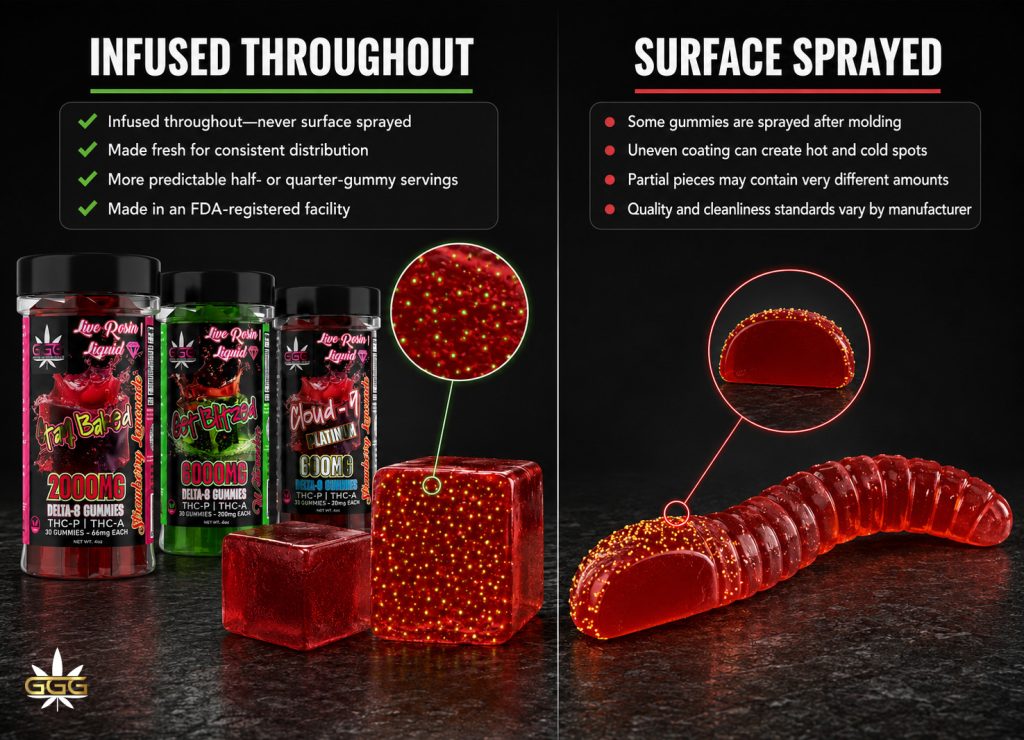
Sometimes the consumer is not the problem—the product is.
Many THC gummies are manufactured by spraying or coating cannabinoids onto the outside of a finished gummy. This can create uneven cannabinoid distribution, especially when the coating process is poorly controlled.
One piece may feel stronger while another from the same container feels surprisingly weak.
Triple G Hemp™ gummies are infused, meaning the cannabinoid formulation is incorporated throughout the gummy rather than sprayed onto its surface. This produces a much more consistent and accurate amount from piece to piece.
Infusion also prevents the active ingredients from rubbing off inside the jar or concentrating unevenly on the exterior.
When consumers are trying to understand their ideal amount, consistent manufacturing is critical. You cannot evaluate how your body responds to 25mg if the product does not reliably contain 25mg in every gummy.
Reason #7: Heat, Age, or Improper Storage May Have Affected the Product
Cannabinoids can degrade when repeatedly exposed to excessive heat, light, air, or moisture.
THC gummies should be:
- Kept tightly sealed
- Stored away from direct sunlight
- Protected from excessive heat
- Kept in a dry location
- Used before their expiration date
- Stored securely away from children and animals
A gummy left in a hot vehicle or stored improperly for an extended period may no longer provide the same experience as a fresh, properly protected product.
Reason #8: Medications or Health Factors May Affect Your Response
Medications and underlying health conditions may influence digestion, liver-enzyme activity, cannabinoid sensitivity, or the overall THC experience.
Do not change prescription medication or increase THC consumption in an attempt to overcome a suspected interaction. Speak with a healthcare professional who understands your medical history.
THC may be inappropriate for certain individuals, including people who are pregnant or nursing or who have particular cardiovascular, psychiatric, or neurological conditions.
Should You Switch to a Stronger THC Gummy?
Possibly—but only after considering the other variables.
Before moving to a higher potency, ask:
- Did I wait long enough?
- Was the gummy fresh and stored correctly?
- Did I consume it under similar food conditions?
- Is the product infused and independently tested?
- Have I developed significant tolerance?
- Do I understand the milligrams in each gummy?
- Am I legally permitted and medically able to use THC?
Consumers who consistently find low-potency Delta-8 products too mild may prefer a higher-strength option. However, the jump between strengths can be considerable.
A product containing 200mg per gummy should never be approached like one containing 25mg. High-potency products are intended for highly experienced adults who already understand their response to THC.
Start with a fraction when appropriate, wait for the complete onset window, and never treat an entire gummy as the default serving simply because it is one piece.
Final Thoughts: Why THC Gummies Affect Everyone Differently
If THC gummies do not seem to work for you, there may not be one simple explanation.
Metabolism, tolerance, digestive absorption, food intake, waiting time, product potency, and manufacturing consistency can all influence the experience.
The smartest response is not to consume multiple gummies rapidly. Instead:
- Use an infused, independently tested product
- Verify the amount per gummy
- Keep your food routine reasonably consistent
- Allow sufficient time for onset
- Consider your current tolerance
- Increase potency only gradually and responsibly
- Never drive after consuming THC
Some people prefer a low-level Delta-8 experience for relaxation or sleep, while highly experienced consumers may require a considerably stronger product to notice the desired effect. A quality THC lineup should provide those choices while making the potency of each option completely clear.
The right product is not automatically the strongest one. It is the product that provides the appropriate, repeatable experience for the individual using it.