

Kratom is often discussed as though only two stories are possible. In one, it is a miracle plant with no meaningful downside. In the other, every kratom product is treated like the same dangerous substance. Neither story is good education.
A more useful question is this: Why have people used kratom for generations, what benefits do modern adults report, and how much confidence should we place in the evidence? Those questions matter because kratom is not one uniform product. Traditional leaf, plain powder, mitragynine-standardized extracts, and concentrated 7-hydroxymitragynine products can differ dramatically in chemistry, potency, and risk.
This guide is the positive companion to our article on kratom side effects, tolerance, and dependence. Responsible education has to discuss both sides. Potential benefits help explain kratom’s staying power; responsible-use principles help protect the very benefits people are seeking.
| IMPORTANT PERSPECTIVE Kratom and its alkaloids are not FDA-approved to diagnose, treat, cure, or prevent any disease. Most benefit data come from traditional use, surveys, observational research, and short-term real-world reports—not large clinical trials. |
In this guide, we’ll cover:
- How kratom has traditionally been used in Southeast Asia
- The benefits people most often report: energy, focus, comfort, relaxation, and improved daily function
- What current human research supports—and what it still cannot prove
- Why the experience can change with product type, amount, and individual biology
- How measured mitragynine extracts differ from concentrated 7-OH products
- Practical ways adults can reduce risk and make more informed decisions
What Is Kratom?
Kratom comes from the leaves of Mitragyna speciosa, a tropical tree in the coffee family native to Southeast Asia. The leaf contains dozens of naturally occurring alkaloids. Mitragynine is generally the most abundant and best studied; natural leaf also contains much smaller amounts of 7-hydroxymitragynine, commonly shortened to 7-OH.
Those alkaloids interact with several biological systems. Some activity involves opioid receptors, but kratom’s pharmacology is not identical to conventional opioids. Mitragynine also interacts with non-opioid pathways. That mixed pharmacology is one reason the experience can be difficult to reduce to a simple “stimulant” or “sedative” label.
For a deeper foundation, read What Is Kratom? Understanding Mitragynine & How Kratom Works.
Centuries of Traditional Use
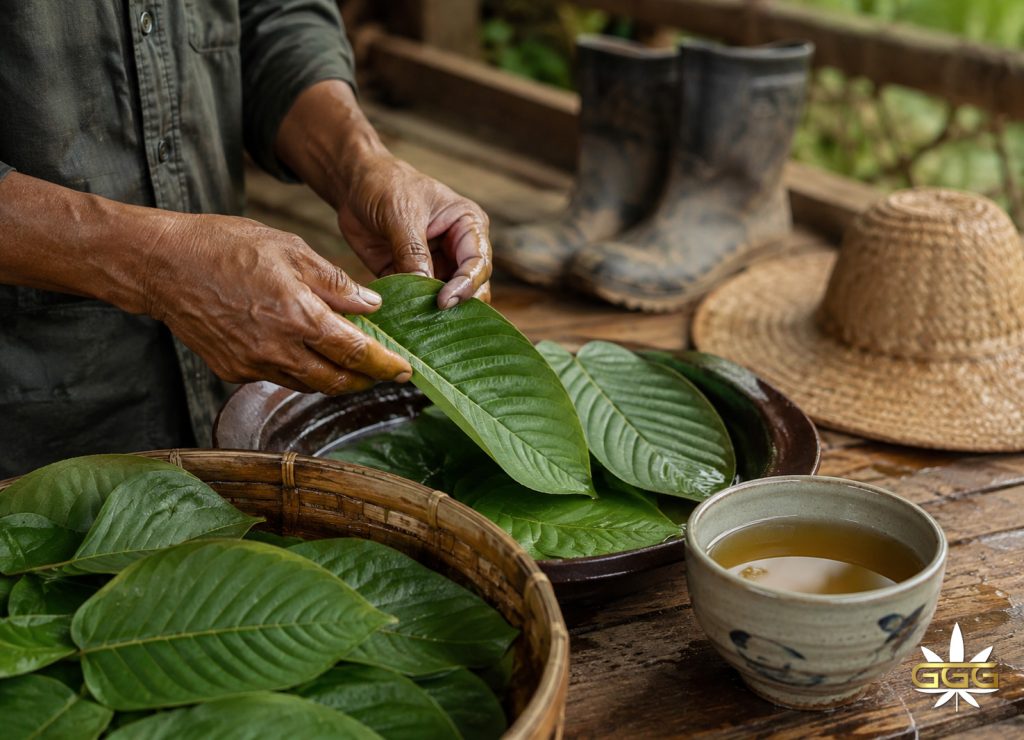
Long before capsules, shots, or online retailers existed, people in parts of Thailand and Malaysia chewed fresh kratom leaves or brewed them as tea. Ethnographic and scientific reviews describe use among laborers seeking stamina, productivity, and relief from the strain of physically demanding work. Traditional use has also included comfort, relaxation, and a variety of folk-health purposes.
Tradition is meaningful evidence of cultural history and long-term human exposure, but it is not the same thing as a modern randomized clinical trial. It also does not automatically transfer to every product sold today. A leaf chewed or brewed in a community setting is not chemically identical to a highly concentrated extract—or to a product enhanced with isolated 7-OH.
A healthcare-provider review summarizes this history and the modern evidence base. Read the peer-reviewed review.
What Benefits Do Kratom Users Most Often Report?
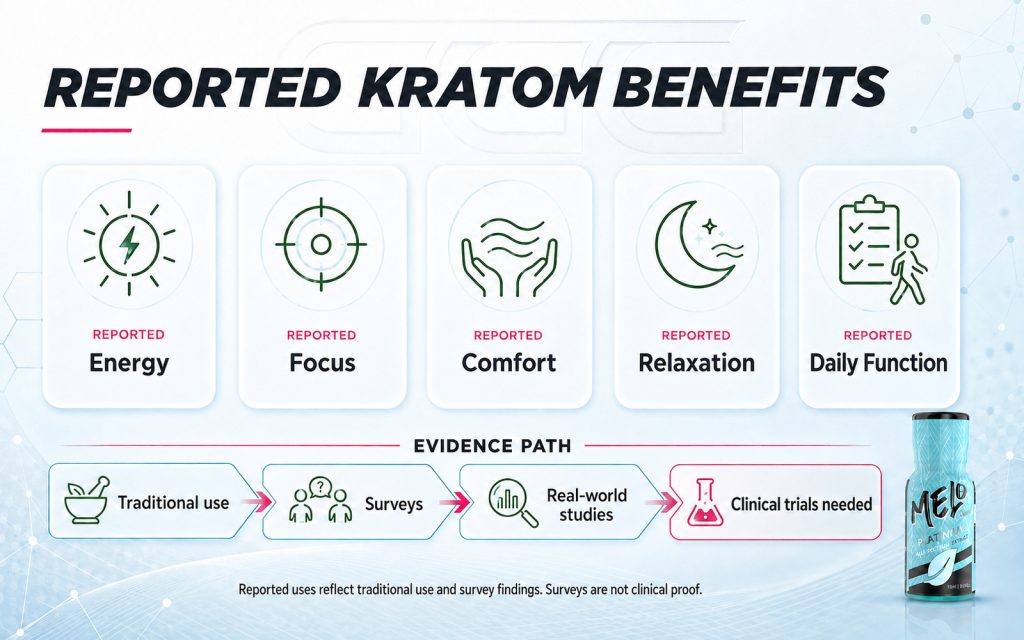
Research has not established kratom as an approved treatment. Still, repeated patterns appear across surveys and real-world studies. These reports are valuable because they tell researchers why people use kratom and what outcomes deserve controlled study.
1. Energy and productivity
One of kratom’s oldest reported uses is support for stamina during long workdays. Modern users likewise describe feeling more energetic, motivated, or able to complete routine tasks. In a 2024 ecological momentary assessment study—where frequent users reported their experiences in real time—increased energy and productivity were among the common immediate motivations for use.
That does not mean kratom works like caffeine for everyone. Some people feel relaxed rather than activated, and the response can shift with the preparation, alkaloid profile, amount, timing, food intake, tolerance, and individual metabolism.
See the 2024 real-world assessment study. Read the study.
2. Focus and task engagement
Energy and focus are related but not identical. Users sometimes describe a narrower, more engaged state that helps them stay with a task. Surveys cannot tell us whether this reflects a direct cognitive effect, improved comfort, greater motivation, expectancy, or some combination. Controlled cognitive studies are still needed.
The responsible takeaway is not that kratom is a proven nootropic. It is that focus is a consistent real-world report—and one worth studying with standardized products, objective performance measures, and transparent alkaloid testing.
3. Physical comfort
Pain and physical discomfort are among the most frequently reported reasons adults use kratom in the United States. Some people describe general day-to-day comfort; others report using it in the context of chronic pain. Observational research can document those reports, but it cannot establish that kratom is safe or effective for a particular condition.
There is another important distinction: feeling less discomfort in the moment is not the same as treating the cause of pain. New, severe, unexplained, or worsening pain deserves medical evaluation. Kratom should not be used to delay diagnosis or replace a clinician-directed treatment plan.
4. Relaxation and a calmer evening
Kratom can also be described as relaxing, settling, or mood-supportive. This apparent contrast with energizing reports is one of the plant’s most discussed features. Preparation and amount may influence the direction of the experience, but simple charts that promise “low equals energy, high equals sedation” are too certain. Human responses overlap, and extracts make gram-based leaf comparisons especially unreliable.
Our dedicated guide explores this variability in more detail: Kratom for Energy vs Relaxation: Traditional Uses Explained.
5. Better day-to-day function
For many users, the goal is not a dramatic sensation. It is function: getting through work, moving more comfortably, completing household tasks, or feeling more present. That is an important research outcome because a small change in daily function may matter more to someone than a large change on a laboratory scale.
At the same time, function can quietly decline if use becomes compulsive, servings keep rising, or discomfort between servings starts driving the routine. The useful question is not only “Do I feel something?” but also “Is this pattern genuinely helping my life over time?”
What Does the Research Actually Show?
The modern kratom evidence base is growing, but it remains uneven. Surveys involving thousands of adults repeatedly identify energy, focus, pain relief, mood, and withdrawal self-management as common reasons for use. Real-time assessment studies add detail by capturing motivations and effects close to the moment of use.
Those studies have real value, but they share limitations. People who choose to use kratom are not randomly assigned. Products vary. Serving amounts may be estimated rather than verified. Outcomes are often self-reported. Participants recruited online may not represent every consumer. And an association between use and a reported benefit does not prove the product caused the benefit.
Large, well-controlled clinical trials with standardized preparations are still scarce. That means the most accurate 2026 conclusion is neither “kratom has no benefits” nor “kratom is proven medicine.” The accurate conclusion is that reported benefits are consistent enough to justify serious research, while clinical certainty remains limited.
Evidence ladder: traditional use and surveys can identify signals; controlled human trials are needed to confirm efficacy, serving ranges, long-term safety, and who is most likely to benefit or be harmed.
Why Can Kratom Feel Energizing or Relaxing?
Kratom is a multi-alkaloid botanical, not a single purified molecule. Mitragynine is the main alkaloid in most conventional leaf, but minor alkaloids and the body’s metabolism may contribute to the overall experience. Different products can therefore produce different ratios and total exposures even when labels use the same word: kratom.
The amount matters, but it is only one variable. A person’s tolerance, body composition, medications, sleep, hydration, meal timing, and prior exposure can all change the response. This is why chasing an effect based on someone else’s gram number—or assuming a liquid extract is equivalent to powder by volume—is a poor strategy.
If timing is the question, see How Long Does Kratom Last? Effects Timeline by Dose & Type.
Traditional Leaf, Mitragynine Extract, and 7-OH Are Not the Same Product
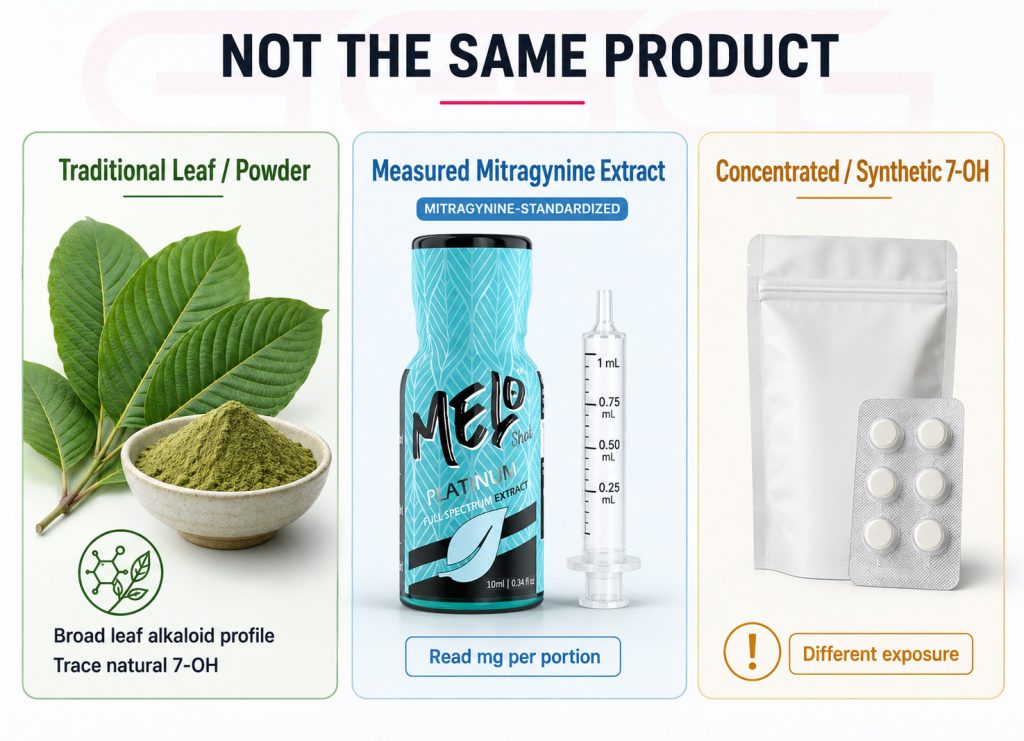
This is the most important product distinction in the modern kratom conversation.
Traditional leaf and plain powder
Leaf and powder contain a broad naturally occurring alkaloid profile, usually with mitragynine as the dominant alkaloid and only trace natural 7-OH. Potency still varies by batch, growing conditions, processing, and storage. “Natural” does not mean risk-free, but it does describe a different chemical profile from isolated or enhanced products.
Mitragynine-standardized extracts
Extracts concentrate selected alkaloids into a smaller volume. A responsible extract label should clearly state the amount of mitragynine per container and per marked portion, make the number of portions obvious, and provide batch testing. Concentration can improve measurement and convenience, but it also reduces the margin for guessing.
Concentrated or synthetic 7-OH products
Products built around added, isolated, or chemically converted 7-OH should not be treated as interchangeable with conventional leaf. In July 2026, federal agencies began a temporary scheduling process aimed at 7-OH above a proposed threshold and several synthetic derivatives. The agencies explicitly said the action was intended to target concentrated and synthetic 7-OH products—not natural kratom leaf containing trace levels.
Read the FDA’s July 2026 update on 7-OH products.
Preclinical research also supports the need for this distinction: 7-OH is pharmacologically more potent at key opioid receptors than mitragynine and may carry a different reinforcing and respiratory-risk profile. Product names and front-label marketing are not enough; the certificate of analysis matters.
Where Melo™ Platinum Fits
Melo™ Platinum is a liquid kratom extract standardized around mitragynine—not a concentrated 7-OH tablet. The 10 mL bottle contains 200 mg of mitragynine. That equals approximately 20 mg per mL; the labeled 3.3 mL portion provides about 66 mg. A full bottle is not automatically a single serving.
For context, conventional kratom powder is often estimated around 10–20 mg of mitragynine per gram, though real batches vary. The labeled 3.3 mL Melo™ portion can therefore contain mitragynine in the broad neighborhood of several grams of conventional powder. That is a chemistry comparison—not a promise that the two experiences are identical. Powder includes a broader leaf matrix, and individual response still varies.
The value of a concentrated product is not “more at all costs.” It is the ability to see the mitragynine amount, measure a portion, and avoid pretending the whole bottle must be used at once. Anyone choosing an extract should read the label completely, verify whether added 7-OH is present, and treat the marked portion as meaningful.
Explore the Melo™ Kratom education and product page.
Responsible Use Helps Protect the Benefits
The pattern of use matters as much as the product. A routine that begins with a clear goal can drift into automatic escalation if the only measure of success is intensity. Responsible use is about keeping the experience deliberate.
- Know the product type. Leaf, powder, mitragynine extract, and concentrated 7-OH are not interchangeable.
- Read milligrams per portion—not just milligrams per bottle. Use a marked measuring tool for liquid extracts.
- Avoid combining kratom with alcohol, opioids, benzodiazepines, sedatives, or other substances that can impair breathing or alertness.
- Do not drive, operate machinery, or perform safety-sensitive work until you know how a product affects you.
- Avoid rapidly increasing the amount to recreate an earlier experience. Rising tolerance is information, not a challenge.
- Take note of frequency. Needing kratom to feel normal, feeling withdrawal between uses, or repeatedly breaking your own limits are reasons to pause and seek help.
- Talk with a healthcare professional if you take medications, have liver, heart, respiratory, seizure, mental-health, or substance-use concerns, or are preparing for surgery.
- Do not use during pregnancy or breastfeeding, and keep all products secured away from children and pets.
For a full discussion of tolerance and dependence, read Part 1: Kratom Side Effects, Tolerance & Dependence.
How to Choose a Better Kratom Product
Because federal standards for retail kratom products remain limited, quality cannot be assumed. A polished package is not a substitute for transparent testing.
- Look for a recent, batch-specific certificate of analysis. The batch number on the report should match the product.
- Confirm mitragynine and 7-OH separately. “Total alkaloids” alone may hide the information consumers most need.
- Review contaminant testing. Microbial contaminants, heavy metals, and adulterants matter in any botanical product.
- Choose clear portion labeling. A liquid bottle should state both the container total and the amount per marked portion.
- Avoid mystery blends and exaggerated medical claims. Transparency is more valuable than dramatic promises.
- Check local law. Kratom rules vary by state and locality and can change.
Frequently Asked Questions
Is kratom FDA-approved?
No. Kratom and its alkaloids are not FDA-approved to treat any medical condition. Retail kratom products also do not have the same premarket review as approved medications.
Does kratom provide energy?
Energy and productivity are common traditional and modern reports, especially with some use patterns. The response is not guaranteed, and controlled evidence remains limited.
Is kratom extract stronger than powder?
Usually, extract contains more concentrated alkaloids in a smaller amount. Compare milligrams of mitragynine and other tested alkaloids—not teaspoons, milliliters, or package size alone.
Is kratom the same as 7-OH?
No. Natural kratom leaf contains trace 7-OH as part of a broader alkaloid profile. Concentrated or synthetic 7-OH products can deliver a very different exposure and should be evaluated separately.
Can kratom be habit-forming?
Yes. Regular use can lead to tolerance, physical dependence, and withdrawal in some people. Risk tends to rise with frequency, total exposure, escalation, and high-potency products.
The Bottom Line
Kratom’s reported benefits are not imaginary simply because clinical research is incomplete. Centuries of traditional use and a growing body of survey and real-world research consistently point to energy, focus, comfort, relaxation, and daily function as important reasons adults use it.
But reported benefit is not the same as approved medical efficacy—and “kratom” is no longer a precise enough product category. Traditional leaf, measured mitragynine extracts, and concentrated 7-OH products need to be discussed on their own terms.
The most responsible path is neither hype nor fear. It is transparent chemistry, measured portions, honest attention to tolerance, and a willingness to stop when the pattern is no longer serving the goal. That is how education protects choice—and how adults protect the benefits they were looking for in the first place.