

Does CBD Show Up on a Drug Test?
CBD has become one of the most popular wellness supplements in the world, with millions of people using cannabidiol products for relaxation, stress support, recovery, sleep, and everyday wellness. But one question continues to dominate search results and customer concerns alike:
Can CBD make you fail a drug test?
The short answer is:
Yes — it can happen.
But the full answer is far more nuanced than most people realize.
Not all CBD products are the same. Different formulations contain different cannabinoid profiles, different THC levels, and different risks depending on how they’re manufactured and tested.
In this guide, we’ll explain:
- how drug tests work
- why some CBD products carry more risk than others
- the difference between full spectrum, broad spectrum, and isolate products
- what causes false positives
- and how to potentially reduce your chances of failing a drug test while using CBD products responsibly.
|
This guide is part of our CBD Education series, where we explore CBD wellness, cannabinoid science, dosing strategies, product quality standards, and the real-world use of premium hemp-derived products.
👉 Explore more CBD guides: Full Spectrum vs Broad Spectrum vs CBD Isolate, CBD vs THC: What’s the Difference?, How Much CBD Should I Take?, and Does CBD Help with Anxiety?
At Triple G Hemp™, we believe education and transparency matter just as much as premium formulations. Consumers deserve real answers — not misleading marketing claims or oversimplified claims designed purely to make sales.
What Do Drug Tests Actually Look For?
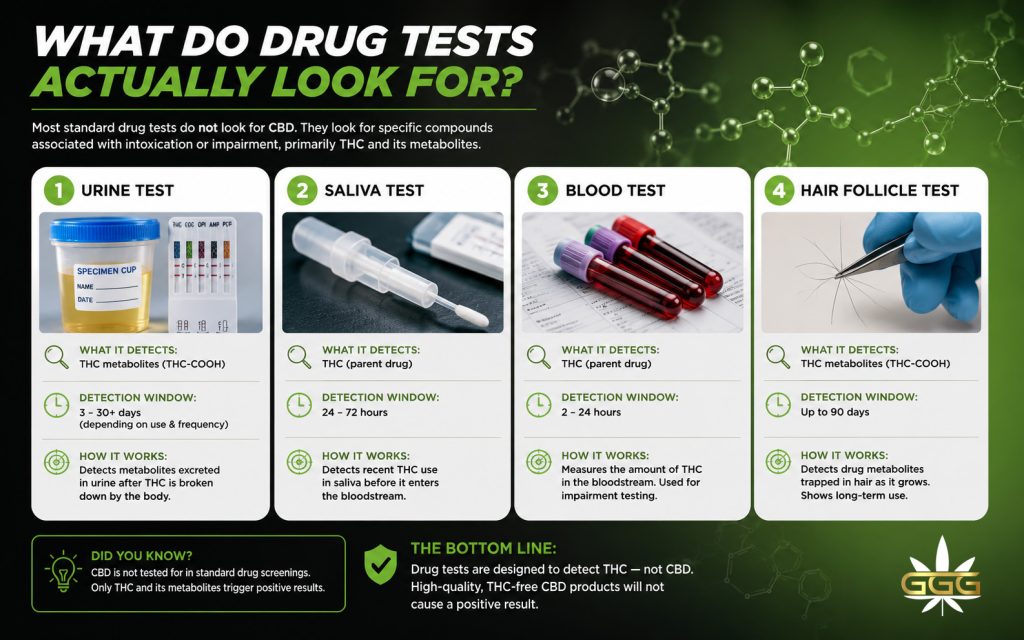
Most standard drug tests are not testing for CBD itself.
Instead, they are typically testing for:
- THC metabolites
- specifically THC-COOH
- which are compounds created after your body processes THC.
The most common forms of testing include:
- urine testing
- saliva testing
- blood testing
- and hair follicle testing.
Urine testing is by far the most common and is especially sensitive to repeated THC exposure over time.
This is where confusion begins for many CBD users.
Because while CBD itself is non-intoxicating, some CBD products may still contain small amounts of THC depending on the formulation.
If you’re unfamiliar with the differences between CBD formulations, we highly recommend first reading our breakdown of 🍃 Full Spectrum vs Broad Spectrum vs CBD Isolate since understanding those differences is critical when discussing drug testing risk.
Does CBD Contain THC?
That depends entirely on the type of CBD product.
Many consumers incorrectly assume all CBD products are completely THC-free. That simply is not true.
There are three primary categories of CBD products:
Full Spectrum CBD
Full spectrum CBD products contain:
- CBD
- minor cannabinoids
- terpenes
- flavonoids
- and trace amounts of THC.
Under federal hemp regulations, hemp-derived products may legally contain up to 0.3% Delta-9 THC by dry weight.
While this is considered a very small amount, repeated daily use may potentially lead to THC accumulation in the body over time.
That means heavy or consistent use of full spectrum products could potentially increase the risk of triggering a positive drug test.
Many consumers intentionally choose full spectrum formulas because they prefer a wider cannabinoid profile and what is often referred to as the “entourage effect.” If you’re newer to cannabinoids in general, our 🍃 CBD vs THC: What’s the Difference? guide explains how these cannabinoids interact differently with the body.
Broad Spectrum CBD
Broad spectrum CBD products are designed to contain:
- multiple cannabinoids
- beneficial hemp compounds
- but little to no detectable THC.
This is often a preferred option for consumers looking for a more cautious approach regarding workplace drug testing concerns.
However, manufacturing quality matters enormously here.
Poorly manufactured or improperly tested broad spectrum products may still contain detectable THC contamination.
That’s one reason why third-party testing and reputable manufacturing standards are so important in the modern hemp industry.
CBD Isolate
CBD isolate products contain purified cannabidiol only.
These products are intended to contain:
- zero THC
- zero additional cannabinoids
- only pure CBD.
Among all CBD categories, isolate products generally carry the lowest potential risk regarding drug testing.
However, no product category can honestly guarantee a person will never fail a drug test under every circumstance.
That’s an important distinction many companies fail to communicate honestly.
Why Some People Fail Drug Tests Using CBD
There are several possible reasons this can happen.
THC Accumulation
Even tiny THC amounts consumed consistently over time may potentially build up in the body.
Factors that influence this include:
- dosage
- frequency of use
- metabolism
- body fat percentage
- potency
- and individual biology.
Someone taking high daily amounts of full spectrum CBD may carry more risk than someone using occasional isolate products.
This is especially true for consumers using stronger wellness formulas daily for recovery, sleep, or stress support.
Poor Manufacturing & Low-Quality Products
This is one of the biggest issues in the hemp industry today.
Some low-cost CBD brands:
- skip proper purification
- use poor extraction methods
- fail potency testing
- or inaccurately label THC content entirely.
In some cases, products marketed as “THC-Free” have later tested positive for measurable THC levels.
That’s why premium manufacturing standards matter.
At Triple G Hemp™, consistency, formulation quality, and third-party testing have always been central to our philosophy. Consumers should know exactly what they are putting into their bodies.
That’s also one reason we focus heavily on education throughout Cannabinoid U™ rather than simply chasing hype or trends.
Can You Fail a Drug Test from Broad Spectrum CBD?
Possibly — although the risk is generally considered lower than full spectrum products.
Broad spectrum formulas are often selected by consumers seeking:
- reduced THC exposure
- workplace peace of mind
- or a more cautious cannabinoid experience.
However:
- no manufacturing process is perfect
- testing thresholds vary
- and individual biology differs from person to person.
This is why trustworthy sourcing, premium extraction methods, and transparent testing matter so much.
Can CBD Cause a False Positive?
True false positives caused by CBD itself are relatively uncommon.
Most positive test results associated with CBD products are actually linked to:
- trace THC exposure
- contamination
- inaccurate labeling
- or cumulative THC intake over time.
In other words:
it usually is not the CBD directly causing the issue.
It is typically the THC content associated with certain hemp products.
How to Potentially Reduce Drug Test Risk When Using CBD

While no product can offer a 100% guarantee, there are several ways consumers may potentially reduce their risk.
Choose Reputable Brands
Always look for:
- third-party testing
- transparent labeling
- verified cannabinoid profiles
- and trusted manufacturing standards.
Premium companies invest heavily in purification, consistency, and quality control.
Consider THC-Free or Isolate Products
Consumers concerned about workplace testing may prefer:
- CBD isolate
- or carefully manufactured broad spectrum products.
These formulations are often selected specifically to help minimize THC exposure.
Avoid Excessive Daily Intake
Large daily amounts of full spectrum products may increase cumulative THC exposure over time.
Consumers using higher strength products consistently should understand this possibility before taking workplace drug tests.
If you’re unsure how much CBD is appropriate for your goals, our 🍃 Beginner CBD Dosage Guide can help explain how serving sizes, potency, and consistency affect overall use.
Review Third-Party Lab Reports
Certificates of Analysis (COAs) can help verify:
- cannabinoid content
- THC levels
- purity
- and product transparency.
Any reputable hemp company should provide accessible testing information for consumers.
Why Honesty Matters in the CBD Industry
One of the biggest problems in the cannabinoid space is oversimplified marketing.
Some companies claim:
- “CBD will NEVER show on a drug test”
- or “THC-Free guaranteed”
without explaining how complicated cannabinoid testing actually is.
That approach creates confusion and damages trust.
At Triple G Hemp™, we believe consumers deserve honest education backed by premium ingredients, verified testing, responsible formulations, and transparent manufacturing standards.
The reality is:
- different CBD products carry different levels of risk
- product quality matters enormously
- and consumers should understand what they’re using before making decisions involving workplace testing.
That honest approach may not always be the flashiest marketing strategy in the industry — but we believe it’s the right one.
Final Thoughts
So… does CBD show up on a drug test?
Most drug tests are not looking for CBD itself.
However, certain CBD products — especially full spectrum formulations containing THC — may potentially increase the risk of a positive THC test depending on:
- usage frequency
- dosage
- product quality
- and individual metabolism.
That’s why understanding the difference between:
- full spectrum
- broad spectrum
- and isolate products
is so important for consumers in 2026.
As the hemp industry continues to evolve, consumers should prioritize:
- transparency
- trusted manufacturing
- verified testing
- and premium formulations from reputable companies.
Because when it comes to cannabinoids, quality and honesty matter.