
At Triple G Hemp™, fibromyalgia is not simply a health topic we selected because people search for it online.
It is part of why this company exists.
GGG™ began in 2012 after our founder searched for a better way to help his mother live with fibromyalgia. Watching cannabinoids make a meaningful difference in her quality of life helped create a company that has now spent nearly 15 years developing products, listening to customers, and refining formulations around what people experience in the real world.
That history does not mean every CBD product works for every person. Cannabinoids affect people differently, fibromyalgia itself is complex, and some customers need help finding the formulation or strength that fits them best.
But it also means one study of one CBD tablet should not be presented as the final answer to a much larger question.
A major randomized trial published for 2026 found that a 50 mg CBD tablet did not outperform placebo for fibromyalgia pain. That result belongs in the conversation. It should be discussed honestly and without trying to hide it.
It must also be interpreted within the boundaries of what researchers actually tested.
The trial did not evaluate full-spectrum CBD oil. It did not compare different cannabinoid profiles, carriers, delivery methods, or purpose-built formulations. It did not individualize the amount beyond a preset ceiling, measure CBD concentrations in participants’ blood, or determine whether different levels of absorption changed the outcome.
Most importantly, it did not evaluate a GGG™ product.
That makes the study useful evidence—but not a universal verdict on CBD for fibromyalgia.
What Is Fibromyalgia?
Fibromyalgia is a chronic condition involving widespread pain, fatigue, sleep disruption, tenderness, stiffness, sensory sensitivity, and cognitive difficulties often described as “fibro fog.”
Although the discomfort may feel as though it originates entirely in muscles and joints, fibromyalgia is not simply an inflammatory joint disorder. Research points toward altered pain processing and increased sensitivity within the nervous system. Sleep, stress, mood, physical activity, immune signaling, hormones, and other health conditions can all influence the experience.
That complexity matters when evaluating any potential support option.
A product could help someone sleep more consistently, calm an overactive stress response, reduce perceived discomfort, or make daily movement easier without producing a dramatic change on one isolated pain score. For someone living with fibromyalgia, those broader quality-of-life changes can be deeply meaningful.
This is one reason research should evaluate the whole person—not only one molecule and one measurement.
What the 2026 CBD Trial Actually Tested
The CANNFIB study was a randomized, double-blind, placebo-controlled trial conducted at one specialized clinic in Denmark.
Researchers screened 273 adults and enrolled 200 people with fibromyalgia. Participants were randomly assigned to receive either CBD or placebo. The CBD group began with one 10 mg oral tablet daily and gradually increased to a maximum of 50 mg per day. Treatment continued for 24 weeks.
At the end of the trial:
- Pain decreased by an average of 0.4 points in the CBD group.
- Pain decreased by an average of 1.1 points in the placebo group.
- The difference favored placebo by 0.7 points.
- CBD did not outperform placebo for sleep, daily function, or quality of life.
- Reported adverse events were generally mild and similar between the groups.
Those results support one clear conclusion: this particular CBD-tablet regimen did not outperform placebo in this particular study population.
That is worth knowing.
However, “this tablet did not beat placebo” and “CBD products do not help people with fibromyalgia” are not scientifically interchangeable statements. Read the published CANNFIB trial.
A Well-Designed Trial Can Still Ask a Narrow Question

The CANNFIB study used a strong randomized and blinded design. There is no need to accuse the researchers of incompetence or claim that the tablets contained no CBD.
The registered investigational product was a 10 mg cannabidiol tablet. “Plant-derived CBD” is also legitimate scientific terminology used to distinguish naturally sourced cannabidiol from synthetic CBD. It is not, by itself, an alarm bell.
The stronger criticism concerns relevance and generalization.
According to the trial’s registered protocol, the study:
- Tested an oral CBD tablet—not full-spectrum CBD oil.
- Used one preset regimen with a maximum of 50 mg daily.
- Did not include a dose-response investigation.
- Did not include pharmacokinetic testing to measure participants’ actual CBD exposure.
- Excluded anyone who had used medical cannabis during the previous six months.
- Excluded people with rheumatoid arthritis or other inflammatory diseases.
- Excluded people with epilepsy or a history of seizures.
- Excluded people with serious chronic diseases or impaired liver or kidney function.
- Excluded people currently using opioids, low-dose naltrexone, or similar strong analgesics.
- Took place at one clinical center.
Those exclusions may help researchers create a more controlled experiment, but they also remove many of the complicated real-world patients who seek cannabinoid support.
The protocol itself classified the study as therapeutic exploratory—not a dose-response, pharmacokinetic, pharmacodynamic, or bioequivalence study. Review the registered CANNFIB protocol.
The fair takeaway is therefore not that the study was worthless. It is that its conclusion should remain attached to the product, population, amount, and delivery method it actually tested.
Why Product Formulation and Delivery Matter
CBD is not absorbed identically from every product.
Cannabidiol is naturally fat-soluble and has variable oral absorption. Even the prescribing information for pharmaceutical CBD reports that food can dramatically change exposure: a high-fat meal increased peak CBD concentration approximately fivefold and total exposure approximately fourfold compared with taking it while fasted.
That does not prove one retail oil is better than a pharmaceutical tablet. It does prove that the milligram number printed on a label does not tell us everything about how much CBD reaches the body. See the pharmacokinetic data for prescription CBD.
Several product characteristics may influence the experience:
- CBD isolate versus a full-spectrum cannabinoid profile
- Tablet, capsule, oil, edible, or other delivery format
- Carrier ingredients and consistency with food
- Actual absorption and metabolism
- Timing and frequency
- Batch potency and stability
- Additional cannabinoids and plant compounds
- Other functional ingredients in the formulation
- The individual’s prior cannabinoid experience and body chemistry
This is why a trial involving isolated CBD tablets cannot automatically answer whether a full-spectrum, lipid-based oil will produce the same result.
It also does not prove that full-spectrum CBD is automatically superior. That would require direct comparative research. It simply means the products are chemically and pharmacologically different enough that one should not be treated as a substitute for studying the other.
For a deeper comparison, read Full Spectrum vs Broad Spectrum vs CBD Isolate.
Extraction and Quality Cannot Be Left Out of the Conversation
A credible cannabinoid study should clearly describe more than the total CBD amount.
Readers and researchers should be able to identify:
- The source and purity of the active ingredient
- Whether the product is isolate, broad-spectrum, or full-spectrum
- Its cannabinoid and terpene profile
- The extraction and purification process
- Its carrier and inactive ingredients
- Testing for potency, contaminants, and residual solvents
- Stability throughout the study
- Whether participants’ actual cannabinoid exposure was measured
GGG™ uses CO₂ extraction as part of our quality-focused manufacturing approach. Properly performed ethanol extraction can also produce a clean product; the genuine red flag is an absent or inadequate testing program—not the name of one extraction method by itself.
The finished formulation, certificate of analysis, potency stability, and batch-to-batch consistency matter more than a vague phrase such as “contains CBD.”
What Other Fibromyalgia Research Shows

The CANNFIB trial is important, but it is not the only relevant evidence.
The 24-Person 1:1 THC:CBD Pilot
A separate 2026 randomized pilot study tested an oil containing 10 mg/mL each of THC and CBD in 24 adults with fibromyalgia.
After titration and 12 weeks of stable use, 70% of participants receiving the cannabinoid oil reported at least a 30% reduction in pain, compared with 40% of the placebo group at week 12. Researchers also found encouraging preliminary signals for sleep and overall fibromyalgia impact.
Because only 24 people participated, the study is too small to provide a final answer. It also tested THC and CBD together, so the results cannot be credited to CBD alone.
But it supports the central point: a cannabinoid oil with a different chemical profile produced a very different signal from the isolated CBD tablet. Different products answer different questions. Read the 1:1 THC:CBD pilot.
The 878-Person CBD Survey
A University of Michigan study examined 878 people with fibromyalgia who currently used CBD products.
Approximately 72% reported substituting CBD for opioids or other pain medications. Many reported reducing or stopping those medications and described better symptom management or fewer unwanted effects.
Because this was a survey, it cannot prove CBD caused those improvements. The products also varied, and the participants were people who had chosen to use CBD.
Still, dismissing the experiences of hundreds of people simply because they occurred outside a laboratory would also be a mistake. The findings reveal a consistent real-world pattern that deserves more targeted investigation. Read the fibromyalgia CBD substitution study.
The 497-Patient UK Registry
A more recent UK Medical Cannabis Registry analysis followed 497 people receiving prescribed cannabis-based products for fibromyalgia.
Researchers found improvements from baseline across fibromyalgia symptoms, pain, anxiety, sleep, and overall quality of life at follow-ups extending to 18 months. Higher CBD exposure and previous cannabis use were associated with better odds of improvement on some fibromyalgia-specific measures.
This was an observational registry without a placebo group, and participants used varied products that could contain CBD, THC, or both. It therefore cannot establish that CBD alone caused the outcomes.
It does, however, show why real-world evidence can point in a different direction from a tightly restricted single-product trial. Read the 497-patient registry study.
A 2023 systematic review likewise found low-quality but generally supportive evidence for short-term pain reduction from cannabinoid therapies in fibromyalgia, while emphasizing the need for better research. Read the systematic review.
What Nearly 15 Years of GGG™ Experience Adds
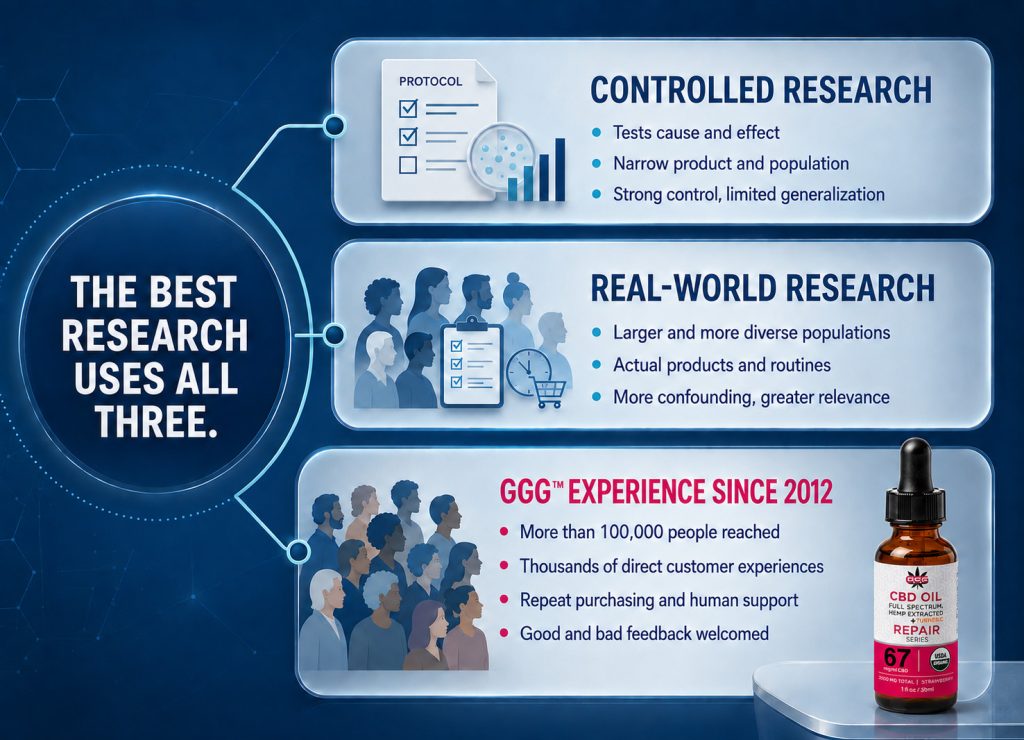
Controlled trials and real-world evidence are not enemies. They answer different questions.
A randomized trial is designed to determine whether an intervention caused a measurable result under controlled conditions.
Real-world evidence shows what happens when actual people use actual products while living complicated lives that rarely fit neatly inside a research protocol.
Since 2012, GGG™ has reached more than 100,000 people. Through customer calls, emails, repeat orders, personal relationships, refunds, and years of direct feedback, we have heard thousands of stories from people using cannabinoids for fibromyalgia, rheumatoid discomfort, sleep disruption, neurological conditions, and other quality-of-life challenges.
For customers who speak with us specifically about fibromyalgia or rheumatoid arthritis, meaningful improvement has been the overwhelming pattern—not the rare exception.
That does not mean every person responds. Some do not. When a customer is not getting the desired result, we work with them to determine whether a different strength, format, or formulation may fit them better. If we cannot help, we stand behind our money-back guarantee.
We are not presenting that experience as a randomized clinical trial. Not every customer reports an outcome, diagnoses are not independently verified, and there is no placebo group.
But nearly 15 years of product-specific feedback, repeat purchasing, extremely rare lack-of-benefit returns, and customers who notice immediately when they run out should not be treated as meaningless noise.
It is a real-world signal—and a powerful reason to conduct better research using the products and formulations people actually rely on.
Why GGG™ Products Are Not the CANNFIB Tablet
The CANNFIB trial tested a single-ingredient CBD tablet at a fixed maximum amount.
GGG™ products are developed around a different philosophy.
Our REPAIR Full-Spectrum CBD Oils use CO₂-extracted full-spectrum hemp in an oil-based formulation and include turmeric as part of the broader wellness formula. The 2,000 mg bottle provides approximately 67 mg of CBD per full 1 mL serving, with a graduated dropper that allows the amount to be measured and adjusted consistently.
Our Panidiol™ Joint Formula was developed as a purpose-built option for customers focused on joint and body-wide comfort rather than as a generic CBD tablet thrown into a bottle.
These products have not been tested against placebo specifically for fibromyalgia, so we are not claiming the CANNFIB result proves GGG™ works—or that our customer experience substitutes for controlled research.
We are explaining why that study did not test our products and cannot fairly be used to declare that all CBD formulations are ineffective.
How to Recognize an Overstated Research Headline
When a headline says “CBD does not work,” ask the following questions:
- What exact product was tested?
Was it CBD isolate, full-spectrum extract, broad-spectrum extract, or a CBD-and-THC combination? - How was it delivered?
A swallowed tablet, sublingual oil, edible, and inhaled product can produce very different absorption patterns. - Was the amount individualized?
One fixed amount may be too little for some participants and unnecessary for others. - Was actual exposure measured?
Without pharmacokinetic testing, researchers know how much was administered—not necessarily how much reached each participant’s circulation. - Who was excluded?
A narrowly selected clinical population may not represent people with multiple conditions, medications, previous cannabinoid experience, or inflammatory disease. - Does the headline match the conclusion?
“One 50 mg CBD tablet did not outperform placebo” is accurate. “CBD is useless for fibromyalgia” is not. - Were competing formulations studied?
A trial cannot tell us whether another product works if that product was never included.
That is not rejecting science. It is reading science correctly.
Honest Safety Information Without Fearmongering
CBD is non-intoxicating, and its anti-seizure activity is not theoretical. Randomized trials demonstrated significant seizure reductions in severe epilepsy syndromes, leading to the approval of prescription cannabidiol for Dravet syndrome, Lennox-Gastaut syndrome, and tuberous sclerosis complex. In the landmark Dravet trial, 43% of CBD recipients achieved at least a 50% reduction in convulsive seizures compared with 27% on placebo. Read the randomized Dravet CBD trial.
Therefore, including “history of seizures” in the CANNFIB exclusion criteria should not be interpreted as evidence that CBD causes seizures. It means researchers excluded that population from this particular fibromyalgia protocol.
Liver warnings also require context. Dose-related liver-enzyme elevations have occurred with prescription CBD, particularly at hundreds or thousands of milligrams per day and among patients also taking valproate or clobazam. That is a real interaction to monitor in those settings.
It does not support casually telling every wellness consumer that ordinary CBD use damages the liver. In the 50 mg CANNFIB trial, adverse events were generally mild and similarly distributed between CBD and placebo.
The most useful practical caution is simple: people taking multiple medications should review potential interactions, keep their product and routine consistent, and avoid abruptly replacing prescribed care. That is responsible education—not a suggestion that CBD is inherently dangerous.
A Better Way to Evaluate CBD for Fibromyalgia
For someone deciding whether a CBD product is making a meaningful difference, the goal should not be to chase a laboratory number or someone else’s perfect serving.
Track real outcomes:
- Average daily discomfort
- Morning stiffness
- Nighttime awakenings
- Sleep quality
- Daytime energy
- Ability to walk, work, cook, or exercise
- Reliance on other as-needed support
- Unwanted effects
- Overall quality of life
Use one clearly labeled, batch-tested product consistently before changing several variables at once. Record the formulation, serving amount, timing, and results.
Our CBD dosage guide explains how to find an individualized routine, while How Long Does CBD Take to Work? explains why timing and consistency affect the experience.
Help Build Better Real-World Evidence
GGG™ encourages customers to share their experiences—good or bad.
We want to know:
- Which product and formulation they used
- How consistently they used it
- Which measurable parts of daily life changed
- How long it took to notice a difference
- Whether the product failed to meet their needs
- Whether they would permit their experience to be shared anonymously with qualified research partners
A properly structured, privacy-conscious customer outcomes program could turn years of lived experience into stronger product-specific real-world evidence.
That is the research we want to see: transparent, adequately sized, long enough to matter, and built around tested products people genuinely use.
Frequently Asked Questions
Does CBD help fibromyalgia?
Many people with fibromyalgia report meaningful improvements from CBD and cannabinoid products, and several surveys and observational studies support those experiences. One 200-person trial found that a specific 50 mg CBD tablet did not beat placebo. That result does not establish that every CBD formulation will produce the same outcome.
Did the 2026 study prove CBD does not work?
No. It showed that one oral CBD-tablet regimen did not outperform placebo in a selected population. It did not test full-spectrum oil, individualized amounts, purpose-built formulations, or GGG™ products.
Why might full-spectrum oil feel different from a CBD tablet?
Full-spectrum oil contains CBD alongside additional hemp compounds and uses a lipid-based carrier. Product composition, food, absorption, metabolism, and delivery method can all alter cannabinoid exposure and experience. Direct fibromyalgia trials comparing these formats are still needed.
Was the study only 24 people?
No. The negative CBD-only CANNFIB trial enrolled 200 participants. A different 24-person study tested 1:1 THC:CBD oil and produced encouraging preliminary results for pain, sleep, and overall fibromyalgia impact.
Does CBD damage the liver?
High-dose prescription CBD has produced liver-enzyme elevations, particularly alongside certain antiseizure medications. That evidence should not be generalized into a claim that normal retail CBD use routinely damages healthy livers. Dose, medications, formulation, and individual health all matter.
Is CBD proven to help seizures?
Purified CBD has demonstrated anti-seizure efficacy in randomized trials and is an approved prescription treatment for seizures associated with several specific epilepsy syndromes. That does not mean every person becomes completely seizure-free or that prescribed antiseizure care should be changed without clinical supervision.
The Bottom Line
The 2026 CANNFIB trial deserves a place in the fibromyalgia conversation.
It tells us that one 50 mg CBD tablet did not outperform placebo in 200 carefully selected participants. It does not tell us that every full-spectrum oil, cannabinoid profile, delivery method, individualized routine, or purpose-built formulation will produce the same result.
Other published evidence—including an encouraging 1:1 THC:CBD pilot, an 878-person CBD survey, a 497-patient medical-cannabis registry, and a broader systematic review—shows that the complete picture is far from settled.
GGG™ also brings nearly 15 years of real-world experience that cannot be recreated by one narrow trial. We have watched cannabinoids make meaningful differences for thousands of people and families, beginning with our own.
We will never claim that one product works for everyone. We will continue helping customers find the formulation that works best for their individual body—and refunding those we cannot help.
But we will also not pretend that nearly 15 years of results disappear because one isolated CBD tablet lost to placebo.
The correct conclusion is not “science proved CBD does nothing.”
It is that cannabinoid research still has a long way to go—and future studies must test the formulations, delivery methods, individualized routines, and real-world populations that actually define how people use CBD.