

How Much CBN Should You Take for Sleep?
CBN has quickly become one of the most talked-about cannabinoids for nighttime wellness—but figuring out how much to take is not always straightforward.
Some products contain CBN by itself. Others combine it with CBD, Delta-8 THC, melatonin, or calming botanical ingredients. Product concentrations vary, individual responses differ, and controlled human research is still relatively new.
That means there is no single CBN amount guaranteed to work for everyone.
The right approach depends on your cannabinoid experience, sensitivity, sleep goals, product formulation, medications, and how your body responds over several nights.
In this guide, we’ll explain:
- what current CBN sleep research has examined
- how beginners should approach CBN
- why the complete formulation matters
- when to take CBN before bed
- how CBN may affect sleep onset and nighttime awakenings
- possible side effects and morning grogginess
- and how to evaluate whether your serving is appropriate.
This guide is part of our Sleep & Relaxation Series, where we explore CBD, CBN, THC, sleep science, nighttime routines, and responsible cannabinoid use.
👉 Explore more sleep guides: Does CBN Cause Morning Grogginess?, CBN vs Melatonin: Which Is Better for Sleep?, CBD vs CBN for Sleep, and How Long Before Bed Should You Take CBD, CBN or THC Gummies?.
CBN research is becoming more informative, but it has not yet established one universal sleep dosage.
What Is CBN?
Cannabinol, or CBN, is a cannabinoid found naturally in hemp and cannabis.
CBN forms partly as THC ages and oxidizes. However, CBN is chemically distinct from THC and is generally described as producing much weaker intoxicating activity.
Its long-standing reputation as the “sleepy cannabinoid” originally grew faster than the scientific evidence supporting it. Many early claims were based on anecdotes, aged cannabis products containing multiple compounds, or animal research rather than controlled studies of isolated CBN in humans.
That is beginning to change.
Recent randomized studies have investigated specific amounts of CBN and measured sleep quality, nighttime awakenings, overall sleep disturbance, next-day fatigue, and other outcomes. The findings provide encouraging clues while also showing that CBN does not affect every part of sleep equally.
What Does Research Say About CBN Dosage for Sleep?
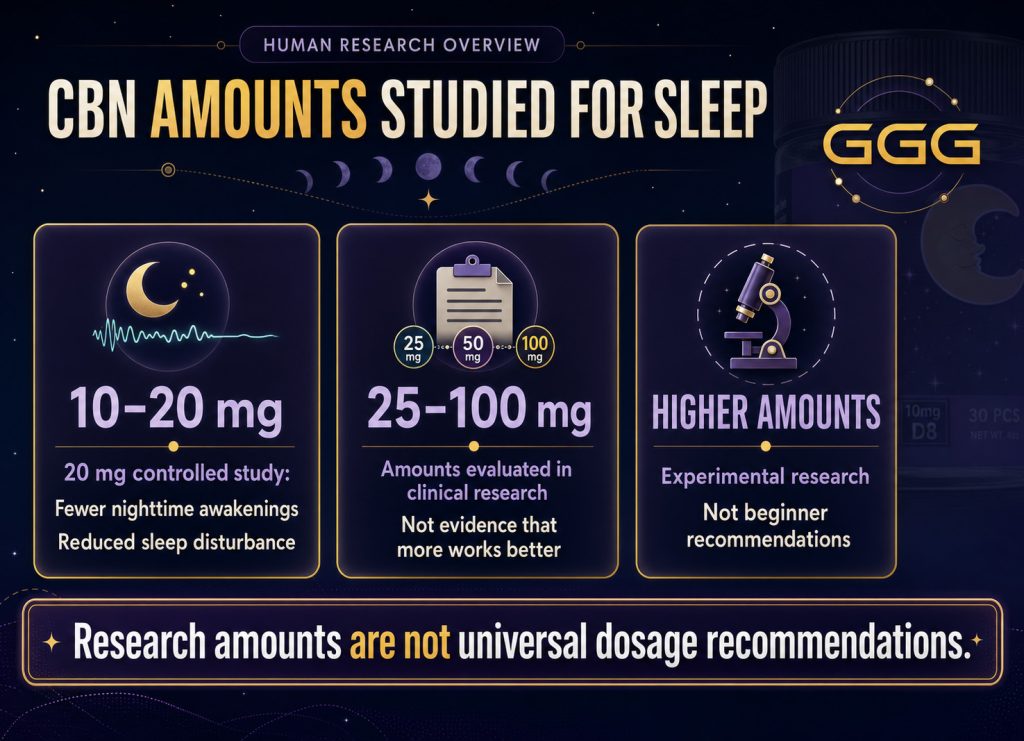
One of the most useful human studies evaluated 20mg of CBN taken nightly in adults who rated their sleep quality as poor or very poor.
Compared with placebo, 20mg of CBN significantly reduced the number of nighttime awakenings and overall sleep disturbance. Researchers did not find a significant improvement in the amount of time required to fall asleep or the time participants remained awake after initially falling asleep.
Importantly, the study did not find increased daytime fatigue. Adding CBD to the CBN formulation also did not provide a clear additional benefit within that particular trial. Read the randomized CBN sleep study.
Another randomized trial investigated oral CBN amounts of 25mg, 50mg, and 100mg. Researchers reported improvements across several sleep measures and found the tested amounts generally well tolerated within the study population. Review the study.
Additional clinical research has examined considerably larger experimental amounts, including 30mg and 300mg. Those studies are valuable for understanding CBN’s pharmacology, but a research amount should never automatically be treated as a consumer recommendation.
Taken together, current evidence suggests that CBN may influence sleep, particularly sleep disturbance and nighttime awakenings. It does not establish that more CBN always produces better sleep.
Is 20mg the “Best” CBN Dosage?
Not necessarily.
The 20mg amount is notable because it has been evaluated in a relatively large placebo-controlled human trial. That makes it a useful research reference—not a universal starting requirement.
A consumer may respond to less, particularly when CBN is combined with THC or other cannabinoids. Another person may use a CBN-only product and respond differently.
The complete experience can be affected by:
- CBN per serving
- Presence and amount of THC
- Presence and amount of CBD
- Other cannabinoids or botanical ingredients
- Previous cannabinoid experience
- Body weight and metabolism
- Food intake
- Sleep schedule
- Medications
- Individual sensitivity
Milligrams cannot be evaluated in isolation from the rest of the formula.
A Conservative CBN Approach for Beginners
Because there is no clinically established universal dosage, beginners should take a conservative, step-by-step approach.
Step 1: Read the Entire Supplement Facts Panel
Determine how much CBN is present per gummy or measured serving, not merely in the complete jar.
Then identify every other active ingredient.
A gummy containing CBN alone is very different from one combining CBN with CBD and Delta-8 THC. Even if both products contain the same amount of CBN, the combined formula may produce a substantially different experience.
Step 2: Begin With the Lowest Practical Serving
Use the smallest accurately measurable serving recommended on the product label.
If the product contains THC and the gummy is designed to be divided, a new or sensitive consumer may consider a smaller portion rather than automatically consuming a full gummy.
This only works reliably when the gummy is infused throughout. A surface-sprayed gummy may contain more cannabinoids in one area than another, making a half or quarter difficult to measure accurately.
Triple G Hemp™ gummies are infused so the active formulation is distributed consistently throughout each gummy. This allows consumers to divide a gummy more confidently when a lower serving is appropriate.
Step 3: Keep the Routine Consistent
Take the same amount under similar conditions for several separate nights before deciding whether it is appropriate.
Try to keep the following reasonably consistent:
- Timing
- Food intake
- Bedtime
- Caffeine and alcohol use
- Other supplements
- Evening activity
Changing several variables at once makes it difficult to determine what influenced the result.
Step 4: Adjust Gradually
If the initial amount is well tolerated but does not provide the intended support, consider a small adjustment on a future night.
Do not take repeated servings during the same evening simply because the effect is not immediate. Gummies require time for digestion and may continue becoming more noticeable after the user assumes they have peaked.
CBN Alone vs a Combined Sleep Formula

A CBN-only product can help someone evaluate their response to that individual cannabinoid. However, many nighttime products combine CBN with other cannabinoids because sleep difficulties rarely have only one component.
A person may struggle with:
- Relaxing mentally before bed
- Physical restlessness
- Falling asleep
- Staying asleep
- Returning to sleep after waking
- Feeling restored the following morning
CBD is commonly included for relaxation and overall balance. CBN is often used to support nighttime rest and reduced sleep disturbance. THC may create a more noticeable relaxing or sedating experience.
Triple G Hemp™ Sleep Ezzz™ Gummies combine CBD, CBN, and Delta-8 THC in one infused nighttime formula. Because Delta-8 is part of the formulation, the appropriate serving should be based on the complete cannabinoid profile, not the CBN amount alone.
Someone with little THC experience should approach a combined formula more cautiously than an isolated CBN product.
How Long Before Bed Should You Take CBN?
Oral cannabinoid products generally require time to pass through the digestive system.
For many people, taking a CBN gummy approximately 30 to 90 minutes before bed provides a reasonable observation window. Some individuals may need longer, particularly after a large meal.
Factors influencing onset include:
- Metabolism
- Product formulation
- Food intake
- Meal size and fat content
- Digestive function
- Other cannabinoids
- Individual sensitivity
Taking CBN at the exact moment you want to fall asleep may not allow sufficient time for an edible product to take effect.
Our complete cannabinoid sleep-timing guide explains how CBD, CBN, and THC products may differ in onset and duration.
Is CBN Better for Falling Asleep or Staying Asleep?
Current evidence suggests CBN may be particularly interesting for people who experience disrupted sleep or repeated nighttime awakenings.
In the 20mg clinical trial, CBN reduced nighttime awakenings and overall sleep disturbance but did not significantly shorten sleep-onset time.
That does not mean CBN cannot help anyone relax before bed. It means the strongest result in that study related to sleep maintenance rather than falling asleep faster.
Someone whose primary difficulty is a racing mind at bedtime may respond differently from someone who falls asleep easily but wakes repeatedly at 2 or 3 AM.
Sleep goals should influence how a person evaluates the product.
Can You Take More CBN if You Wake During the Night?
Taking another edible cannabinoid product during the night can be risky.
A second serving may not take effect until much later, potentially increasing:
- Morning grogginess
- Oversleeping
- Impaired coordination
- Difficulty concentrating
- Next-day cannabinoid effects
Products containing THC require even greater caution because their effects may last for several hours.
Rather than immediately redosing, evaluate the original serving, timing, and formulation across several nights. If repeated awakenings continue, consider whether sleep habits, stress, pain, medications, alcohol, sleep apnea, or another underlying issue may be contributing.
Persistent insomnia or frequent nighttime waking should be discussed with a healthcare professional.
Can CBN Cause Morning Grogginess?
CBN does not automatically cause next-day grogginess, but it can happen.
Possible contributing factors include:
- Taking too much
- Taking it too late
- Combining it with THC
- Mixing it with alcohol
- Using other sedating medications or supplements
- Sleeping for too few hours
- Individual sensitivity
Interestingly, the 20mg randomized trial did not find a significant increase in daytime fatigue. However, real-world products and individuals vary, especially when CBN is combined with THC.
If you wake feeling unusually sluggish, reduce the serving, take it earlier, or discontinue the product. Never drive until you fully understand how a cannabinoid sleep formula affects you.
Our guide to CBN and morning grogginess explores this subject in greater detail.
Potential CBN Side Effects
Human CBN safety research remains limited compared with research on CBD or THC.
Potential effects may include:
- Drowsiness
- Dry mouth
- Dizziness
- Changes in appetite
- Digestive discomfort
- Morning grogginess
- Increased effects when combined with other cannabinoids or sedatives
A product containing THC may also cause intoxication, altered perception, anxiety, impaired coordination, or an increased heart rate.
Stop using the product and consult a healthcare professional if you experience a concerning reaction.
CBN and Medication Interactions
CBN may be processed through liver-enzyme pathways involved in metabolizing medications. The clinical significance of many potential interactions has not been fully established.
Consult a healthcare professional before using CBN if you:
- Take prescription medication
- Use sleep aids or sedatives
- Take blood thinners
- Have liver or kidney disease
- Have a cardiovascular or psychiatric condition
- Are pregnant or nursing
- Are preparing for surgery
Do not combine a cannabinoid sleep product with alcohol, prescription sleep medication, or another sedative without professional guidance.
How to Tell Whether Your CBN Serving Is Working
The strongest possible sensation is not the goal. Better sleep is.
Keep a simple sleep record tracking:
- CBN amount
- Other cannabinoids in the formula
- Time taken
- Approximate time you fell asleep
- Number of nighttime awakenings
- Ease of returning to sleep
- Morning energy
- Any side effects
Evaluate trends across multiple nights rather than judging the product from a single experience.
A useful serving should support your sleep goals without causing unacceptable next-day effects.
Choosing a Quality CBN Sleep Product
Look for a product that provides:
- Clearly stated CBN per serving
- Full cannabinoid information
- Independent laboratory testing
- Verified THC concentration
- Heavy-metal and pesticide screening
- Residual-solvent testing
- Microbial safety results
- Consistent manufacturing
- Clear serving instructions
- Reliable batch and expiration information
Infused gummies provide an additional advantage because the active ingredients are distributed throughout the gummy. That creates a more consistent serving and allows the gummy to be divided into halves or quarters when a smaller portion is appropriate.
Quality matters even more with a multi-cannabinoid sleep formula. Inaccurate distribution can make the difference between a restful night and an unexpectedly powerful experience.
Final Thoughts: How Much CBN Should You Take for Sleep?
There is no single CBN dosage that guarantees better sleep for everyone.
Controlled human research has produced encouraging findings at amounts including 20mg, while other trials have examined 25mg, 50mg, 100mg, and higher experimental amounts. These studies help define CBN’s potential, but they do not replace individualized guidance.
The most responsible approach is to:
- Read the complete cannabinoid profile
- Begin with the lowest practical serving
- Consider whether THC is included
- Take it with sufficient time before bed
- Maintain a consistent routine
- Evaluate sleep quality and morning alertness
- Adjust only in small increments
- Avoid mixing it with alcohol or sedatives
- Consult a professional when medications or health conditions are involved
CBN appears especially promising for sleep disturbance and nighttime awakenings, but more is not automatically better.
The best CBN serving is the lowest amount that supports a better night’s rest without creating unwanted effects the following morning.