

CBN has moved from a little-known cannabinoid to a familiar name on nighttime gummies, oils, and capsules. That naturally leads to the next question: If CBN helps make your sleep routine more predictable, can you take it every night—or will it stop working over time?
Yes—for many adults, CBN can be used as part of a consistent nightly sleep routine. Controlled human research has found fewer nighttime awakenings and less overall sleep disturbance with nightly CBN, while nearly 15 years of GGG™ formulation work and customer experience show why ingredient quality, balance, and consistency matter beyond any one isolated cannabinoid.
| THE SHORT ANSWER CBN can fit comfortably into a nightly routine for many adults. Sleep Ezzz™ is built around that real-world use: a melatonin-free blend of CBD, CBN, Delta-8 THC, valerian root, and passion flower developed to support the complete nighttime experience—not simply to put “CBN” on the front of a jar. |
That complete-formula distinction matters. A research capsule containing isolated CBN answers a useful scientific question, but it is not the same product as a sleep gummy developed around winding down, staying asleep, and waking ready for the next day.
Why Sleep Ezzz Is More Than a CBN Gummy
Sleep Ezzz™ Gummies combine CBD, CBN, and hemp-derived Delta-8 THC with valerian root and passion flower in a vegan pectin gummy. CBN is included for nighttime and sleep-maintenance support, CBD creates a balanced cannabinoid foundation, and Delta-8 contributes the relaxing THC component. Valerian root and passion flower complete the formula with two long-used nighttime botanicals.
Those botanicals are deliberate substitutes for the melatonin found in many competing sleep products. The goal was a complete melatonin-free formula that works with a person’s nighttime routine instead of relying on a single ingredient or copying the standard sleep-gummy template.
We cover that choice in depth in CBN vs Melatonin for Sleep.
The formula was refined through large focus groups and feedback from 500 online customers before launch. That process let us evaluate the complete experience across real adult routines and adjust the blend for maximum practical effectiveness before it ever reached the GGG™ family.
Nearly 15 years of direct formulation work adds another layer that a short isolated-compound trial cannot provide. We pay attention to what people actually care about: a predictable wind-down, fewer disruptions, a routine they can repeat, and how they feel the next morning. That is why Sleep Ezzz™ is built as a complete system rather than a generic CBN gummy.
What Is CBN—and Why Is It Used at Night?
Cannabinol, or CBN, is a naturally occurring cannabinoid found in cannabis and hemp. It is often formed as THC ages and oxidizes, but calling it simply “old THC” misses the point. CBN has its own pharmacology and its own role in a well-built nighttime formula.
CBN is not the intoxicating ingredient in Sleep Ezzz™ and does not create the THC-style high associated with Delta-8 or Delta-9. Across nearly 15 years of our own cannabinoid work and thousands of product tests and customer experiences, we have seen zero intoxicating character from CBN itself. In a blended formula that contains Delta-8, any intoxicating effect comes from the Delta-8—not the CBN.
Current human research suggests CBN may be particularly relevant to sleep maintenance—the ability to stay asleep or experience fewer nighttime awakenings. That makes it a natural fit inside a formula designed to support the full night rather than act like an instant knockout switch.
If you want the broader comparison first, read CBD vs CBN for Sleep.
What Human Research Says About Nightly CBN

Human research is beginning to catch up with what experienced formulators and longtime customers have observed: CBN can be a useful nighttime cannabinoid, particularly for sleep maintenance. Two recent controlled studies give that real-world experience a stronger scientific foundation.
The 2024 seven-night trial: fewer awakenings and less sleep disturbance
A randomized, double-blind, placebo-controlled trial enrolled 293 adults who rated their sleep quality as poor or very poor. Participants received placebo, 20 mg of CBN, or 20 mg of CBN combined with different amounts of CBD for seven consecutive nights.
Compared with placebo, 20 mg of CBN reduced the number of nighttime awakenings and overall sleep disturbance. The primary sleep-quality score also moved in a favorable direction.
Read the 2024 randomized CBN sleep trial.
| WHY THIS STUDY MATTERS This was a meaningful human signal: 293 adults, a randomized placebo-controlled design, and seven consecutive nights. The results support CBN’s role in sleep maintenance and help explain why CBN earned its place inside the broader Sleep Ezzz™ formula. |
The 2026 insomnia study: measurable effects on sleep
A second randomized, double-blind, placebo-controlled crossover study looked at 20 adults with physician-diagnosed insomnia. Each participant completed separate laboratory nights with 30 mg of CBN, 300 mg of CBN, and placebo, with washout time between visits.
At 300 mg, researchers found more stage N2 sleep, fewer electroencephalographic arousals, a shorter time to fall asleep, and better self-rated sleep quality. The value of that finding is not the unusually large amount—which should not be treated as a retail recommendation—but the additional evidence that CBN can create measurable changes in human sleep.
Taken together, the 2024 and 2026 studies point in the same useful direction: CBN is biologically active at night, sleep outcomes can change with the amount and formulation, and sleep maintenance remains one of its most promising real-world uses.
See the 2026 controlled CBN insomnia study.
What the studies add—and why formulation still matters
- Controlled human data now support a real CBN sleep signal, especially around nighttime awakenings and sleep disturbance.
- Different amounts and product designs produced different outcomes, reinforcing that the formula matters—not just the letters CBN on a label.
- The research products did not include Sleep Ezzz™’s complete combination of CBD, CBN, Delta-8, valerian root, and passion flower.
- Large focus groups, 500 prelaunch online customers, and nearly 15 years of GGG™ experience add a much broader real-world product-development layer.
Controlled research and real-world formulation experience answer different questions. Used together, they give consumers a much fuller picture than either one can provide alone.
Can You Build a Tolerance to CBN?
CBN is not known for the rapid, obvious tolerance pattern many adults associate with intoxicating THC. Human research has not established a predictable CBN-tolerance timeline, and there is no evidence that every nightly CBN user must continually increase the amount to keep receiving support.
CBN is not THC, so simply copying a Delta-8 or Delta-9 tolerance model onto CBN would be inaccurate. The complete formula, frequency, timing, sleep routine, and individual response all matter.
This distinction is especially important with a blended sleep product. If a formula includes Delta-8 or Delta-9 THC, a person may notice changing effects because of the THC component even when the CBN amount has not changed. That is not proof that CBN “quit working.” It is a reason to look at the entire label before increasing the serving.
A fading nighttime effect is information—not an automatic instruction to take more.
Why Isolated CBN Research Does Not Define Sleep Ezzz

Clinical researchers often isolate one or two variables because that is how they determine what a specific ingredient did. Product formulation solves a different problem: how to build a complete experience for an adult whose sleep may be disrupted by more than one factor.
That is where Sleep Ezzz™ separates itself from a generic CBN gummy. Its CBD, CBN, Delta-8 THC, valerian root, and passion flower were selected as a coordinated melatonin-free blend, then refined with large focus groups and 500 online customers before launch. We did not simply add a fashionable cannabinoid to a gummy and call it a sleep formula.
Customers also do not experience a label one ingredient at a time. Cannabinoid balance, botanical support, gummy digestion, timing, manufacturing consistency, and individual biology all shape the night. A study of isolated CBN can validate an important ingredient without defining what a purpose-built five-ingredient formula can do in the real world.
Is It Safe to Take CBN Every Night?
For adults who tolerate cannabinoid products well, a clearly labeled CBN product can fit a consistent nightly routine. CBN was well tolerated in the short human trials completed so far, and nearly 15 years of GGG™ experience reinforces the value of a measured serving, reliable manufacturing, and a formula designed to be repeated consistently.
The best results come from treating the product as a routine rather than chasing a stronger sensation. Give a gummy its full onset window, pay attention to next-morning clarity, and remember that a complete formula containing Delta-8 deserves the same respect as any other THC product.
- Use the current product label as the starting point; do not borrow a research dose from a study.
- Give an edible its full onset window before deciding it did not work. Taking a second serving too quickly can create a much stronger night than intended.
- Do not drive or perform safety-sensitive work if you feel impaired, and pay attention to next-morning clarity.
- Avoid casually stacking a CBN product with alcohol, sleep medication, antihistamines, or other sedating products.
- If you use prescription medication or have a condition affecting sleep, ask a knowledgeable healthcare professional to review the complete ingredient list and routine.
- Keep gummies and oils secured away from children and pets.
Concerned about the morning after? See Does CBN Cause Morning Grogginess?.
How to Tell Whether Your Nightly Routine Is Still Working
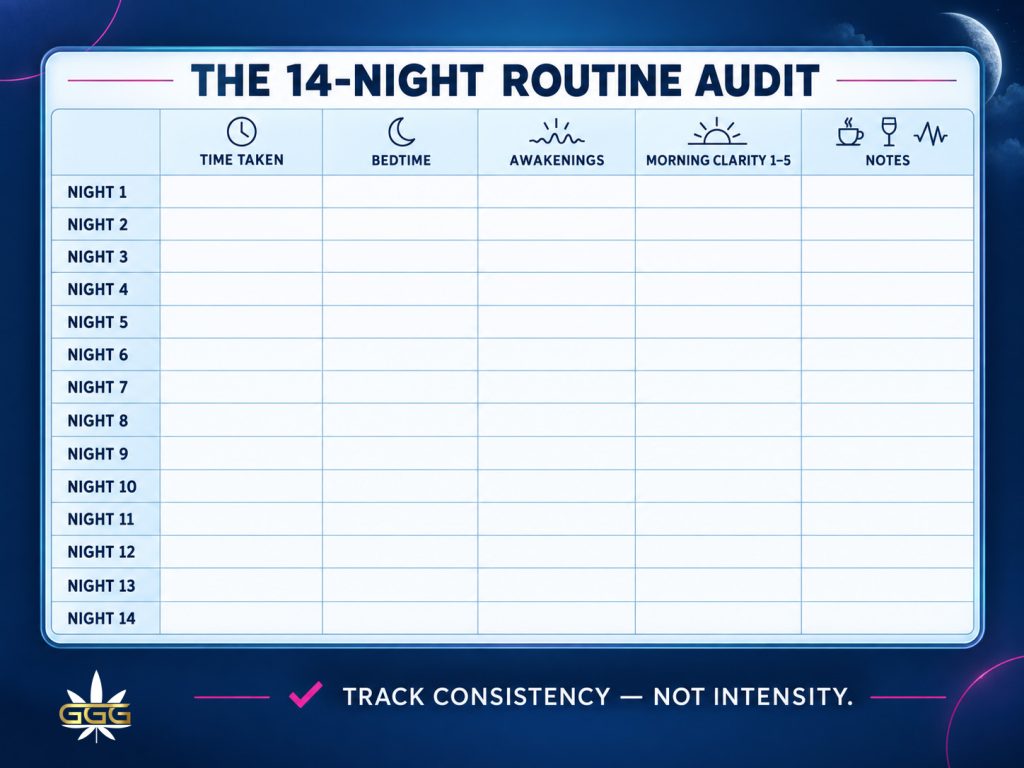
You do not need a laboratory to spot a pattern. A simple 14-night routine audit can separate a genuinely helpful routine from a habit running on autopilot. Keep the product and serving consistent while noting the factors that can distort sleep.
- Record the time you take the product and the time you actually go to bed.
- Track roughly how long it takes to fall asleep and how often you remember waking.
- Rate morning clarity from 1 to 5 instead of judging the night only by how sleepy you felt at bedtime.
- Note late caffeine, alcohol, unusually heavy meals, travel, stress, or a major schedule change.
- At the end of two weeks, look for consistency. Is the same serving still supporting the same goal without creeping upward?
This is personal tracking, not a medical diagnostic test. Its value is that it stops one rough night from becoming a reason to double a serving—and it can reveal when the real disruption is caffeine timing, alcohol, an inconsistent bedtime, pain, stress, or another sleep barrier.
What to Do If CBN Seems Less Effective
Before assuming you have built a CBN tolerance, audit the variables around it.
- Confirm the serving and timing have not drifted. An edible taken after a very different meal may feel delayed.
- Check the complete formula. If it contains Delta-8 or Delta-9 THC, THC tolerance may be part of the change.
- Review caffeine, alcohol, stress, bedtime consistency, and screen-heavy late nights.
- Check storage and the batch-specific certificate of analysis when available. Heat, light, age, and inconsistent manufacturing can affect a cannabinoid product.
- Return to the lowest amount that previously supported the goal rather than escalating for intensity.
- Consider a deliberate pause or fewer-use nights if the routine has become automatic—especially when THC is part of the formula.
A pause is not mandatory for every CBN user, and research has not established a universal CBN reset schedule. It is simply one practical way to reassess baseline sleep and avoid turning a changing response into endless escalation.
When a Nightly Cannabinoid Routine Is Not the Whole Answer
A sleep product can support a routine without explaining why sleep is repeatedly broken. Loud snoring, gasping, witnessed breathing pauses, severe daytime sleepiness, persistent insomnia, restless legs, new nighttime pain, or a sudden major change in sleep deserves professional evaluation. More CBN is not a substitute for identifying an underlying problem.
The same applies when a product creates regular next-day impairment or when you feel unable to sleep without continually increasing it. The goal is better function and more restorative sleep—not simply a stronger sensation at bedtime.
Frequently Asked Questions
Will CBN build tolerance if I take it every night?
CBN is not known for the same rapid tolerance pattern associated with intoxicating THC, and human research has not established a predictable CBN-tolerance timeline. If your product also contains Delta-8 or Delta-9 THC, a changing response may be related to the THC component rather than CBN alone.
Is CBN intoxicating?
No. CBN is not an intoxicating cannabinoid and does not create a THC-style high. Across nearly 15 years of our own cannabinoid work and thousands of product tests and customer experiences, we have seen zero intoxicating character from CBN itself. Sleep Ezzz™ does contain Delta-8 THC, so any intoxicating effect from the complete gummy comes from its Delta-8—not its CBN.
Does CBN make everyone sleepy?
CBN does not need to create a heavy or drugged feeling to be useful at night. Human response varies, but current research points most clearly toward sleep-maintenance support, including fewer awakenings and less overall sleep disturbance. In Sleep Ezzz™, CBN works alongside the rest of the formula rather than carrying the full nighttime routine alone.
Can I take CBN with CBD or Delta-8?
They are commonly combined in formulated sleep products, including Sleep Ezzz™. Use the labeled formula as designed rather than stacking separate products without calculating the complete cannabinoid amount. Remember that Delta-8 changes the impairment and tolerance conversation.
How long before bed should I take a CBN gummy?
Edibles need digestion time, and meal timing can change onset. Many people plan gummies well before lights-out rather than waiting until they are already in bed.
Our timing guide explains the variables: How Long Before Bed Should You Take CBD, CBN or THC Gummies?.
Should I take a CBN break?
There is no research-backed break schedule that every CBN user must follow. A short, deliberate pause can be useful if the effect has faded, your serving keeps increasing, or you want to reassess baseline sleep—especially when the product also contains THC.
Can a CBN product affect a drug test?
Do not assume a cannabinoid sleep product is drug-test safe. Full-spectrum products and formulas containing Delta-8 or Delta-9 THC can lead to a positive THC result. If testing matters, review the label and batch report, and understand that no retail product can guarantee the outcome of every test.
The Bottom Line
CBN can be a valuable part of a nightly routine for many adults, and current human research now supports what experienced formulators and customers have observed. A seven-night trial found fewer awakenings and less overall sleep disturbance with 10 mg of CBN, while a 2026 laboratory study found measurable changes in sleep architecture and self-rated sleep quality.
Sleep Ezzz™ takes that useful cannabinoid and builds beyond it. CBD, CBN, Delta-8 THC, valerian root, and passion flower work as a coordinated melatonin-free formula refined through large focus groups, 500 online customers, and nearly 15 years of GGG™ cannabinoid experience. That is a very different proposition from a generic gummy built around one popular acronym. Use it as labeled, give it proper timing, and judge the whole night and the day that follows.