

Search for “CBD side effects in dogs,” and you will quickly find lists that make CBD sound far more troublesome than the canine research—or years of real-world experience—actually suggest.
So let’s begin with the most important fact:
Properly formulated CBD is generally very well tolerated by dogs.
Controlled studies have administered CBD to healthy dogs daily for six months, nine months, and shorter periods using amounts substantially higher than many everyday retail servings. The overall pattern has remained remarkably consistent: no serious CBD-attributable adverse effects, no pattern of deteriorating health, and only occasional mild observations—usually at the highest experimental amounts.
That scientific record closely matches what Triple G Hemp™ has witnessed since introducing the world’s first CBD dog treats in 2013.
For more than 13 years, Doggy Be Good™ products have been used by thousands—and by now likely tens of thousands—of dogs. We have worked directly with veterinarians, pet stores, and some of the most attentive customers on Earth: dog owners.
Pet parents notice everything. If their dog skips breakfast, walks differently, sleeps longer than usual, or simply “doesn’t seem right,” they are going to ask questions.
Yet across more than a decade of direct feedback, we have not identified a recurring side-effect pattern connected to our CBD dog treats. What we have received are stories about dogs enjoying greater comfort, better routines, improved activity, and a better quality of life.
Customer experience is not a replacement for controlled research. But when more than 13 years of real-world use points in the same direction as the canine safety studies, that experience deserves a place in the conversation.
The Short Answer
CBD itself is non-intoxicating and is generally well tolerated by dogs when provided through a clearly labeled, pet-specific product at an appropriate serving.
A small number of canine studies have reported temporary observations such as:
- soft stool or diarrhea,
- vomiting,
- additional relaxation or sleepiness,
- drooling or hypersalivation,
- and changes in a blood marker called alkaline phosphatase, or ALP.
These are possible observations—not outcomes that most pet owners should expect.
Some occurred only at unusually high research amounts. Others also occurred among placebo dogs or during periods when no CBD was being administered. Stomach changes can additionally come from carrier oils, treat ingredients, abrupt dietary changes, food sensitivities, or one of the hundreds of questionable things dogs enthusiastically eat when nobody is looking.
Most importantly, severe disorientation, urinary dribbling, glassy eyes, extreme sedation, or an inability to walk normally are not typical CBD responses. Those signs deserve immediate attention because they may indicate THC exposure, xylitol ingestion, another toxin, or an unrelated medical problem.
Why GGG™ Has Seen Such Strong Real-World Tolerability
Triple G Hemp™ introduced its original CBD dog treat in 2013, long before pet CBD became an entire retail category.
That early start gave us something newer brands cannot manufacture overnight: more than a decade of feedback from actual dogs, their owners, and veterinary professionals.
Our current Doggy Be Good™ Original Treats contain:
- 700 mg of CBD per jar,
- 10 mg of CBD per labeled serving,
- a familiar treat format,
- clearly stated serving information,
- and a batch-specific Certificate of Analysis.
Our Doggy Be Good™ Soft Chews also provide 10 mg per chew for owners who prefer a smaller, softer format.
This matters because “CBD for dogs” is not one universal product.
A consistent pet treat with a measured serving is completely different from:
- guessing with an unmarked dropper,
- breaking apart a human gummy,
- using a product that does not disclose its cannabinoid content,
- giving a dog a THC-containing edible,
- or buying an unstable formula from a company that may disappear six months later.
When a product is purpose-built for pets, clearly labeled, independently tested, and refined through years of use, the owner is not experimenting with an unknown substance in an unknown amount.
That difference is one reason our own history has been overwhelmingly positive.
What Controlled Canine Safety Studies Actually Found
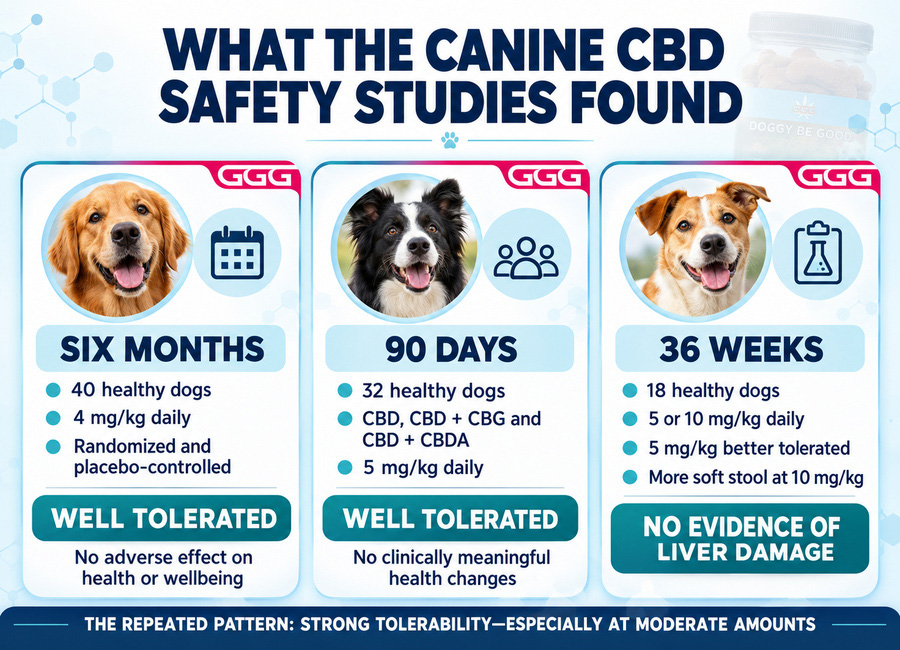
The best way to understand possible CBD side effects is to examine the studies themselves instead of recycling a generic warning list.
Six Months of Daily CBD in 40 Dogs
A randomized, blinded, placebo-controlled study enrolled 40 healthy dogs representing three breeds.
Twenty dogs received broad-spectrum, THC-free CBD once daily at 4 mg per kilogram of body weight for six months. Twenty received placebo capsules.
Throughout the study, researchers conducted:
- veterinary examinations every two weeks,
- twice-daily wellness observations,
- blood chemistry testing,
- blood-cell analysis,
- urinalysis,
- and daily quality-of-life assessments.
The researchers reported no adverse effect on the dogs’ health or wellbeing.
The only notable laboratory finding was a temporary increase in ALP among slightly more than half of the CBD group. Other liver-related measurements did not rise alongside it, the dogs showed no clinical signs of liver trouble, and bone-specific ALP increased at the same time.
The researchers concluded that 4 mg of CBD per kilogram of body weight each day was well tolerated for six months.
For perspective, 4 mg per kilogram would equal approximately 100 mg of CBD every day for a 55-pound dog.
That is ten 10 mg Doggy Be Good™ servings every day—not a recommendation, but valuable context when evaluating the study.
Read the six-month canine CBD study.
Ninety Days Across Three Cannabinoid Formulas
A separate 2024 study divided 32 healthy beagles into four groups:
- a carrier-oil control,
- broad-spectrum CBD,
- CBD combined with CBG,
- and CBD combined with CBDA.
The cannabinoid groups received 5 mg of total cannabinoids per kilogram of body weight daily for 90 days, followed by a 14-day recovery period.
All three formulations were well tolerated. The researchers found no clinically meaningful effects on health, food intake, body weight, urinalysis, blood counts, or general wellbeing.
Some laboratory values moved temporarily, but the researchers determined that the changes were low in magnitude, sporadic, within reference ranges, or not clinically meaningful.
The same paper also examined post-market surveillance from hemp-derived canine supplements sold between 2010 and 2023. The reported rate was approximately 2.10 adverse-event reports per one million administrations sold, with serious reports occurring at approximately 0.01 per million.
That reporting system is industry-generated rather than a randomized clinical trial, but its enormous scale provides useful real-world context—and strongly resembles what we have observed with Doggy Be Good™.
Read the 90-day cannabinoid safety study.
Thirty-Six Weeks at Higher Experimental Amounts
Another long-term study followed 18 healthy beagles for 36 weeks.
The dogs received:
- placebo,
- 5 mg of CBD per kilogram daily,
- or 10 mg of CBD per kilogram daily.
CBD was well tolerated at 5 mg per kilogram. Dogs receiving the larger 10 mg-per-kilogram amount experienced soft stool more frequently, but no other significant clinical adverse events were found.
Both CBD groups experienced increased ALP activity, yet the remaining blood measurements stayed within their reference ranges. The researchers specifically stated that their results did not indicate liver damage.
They recommended sensible veterinary monitoring for dogs receiving CBD chronically, particularly at high amounts or alongside other medications.
Once again, dose context matters. For a 55-pound dog, 10 mg per kilogram would equal approximately 250 mg of CBD every day—25 times a 10 mg Doggy Be Good™ serving.
Read the 36-week canine CBD study.
The ALP Question: A Lab Change Is Not the Same as Liver Damage
ALP stands for alkaline phosphatase. It is an enzyme measured during routine blood testing, but it is not found exclusively in the liver.
An elevated ALP result can come from several sources and must be interpreted alongside:
- other liver enzymes,
- bilirubin,
- bile acids,
- clinical symptoms,
- medications,
- age,
- bone activity,
- and the dog’s complete health history.
That context is critical.
In the six-month CBD study, the dogs with increased ALP did not experience matching changes in the other liver measurements researchers would expect with liver injury. Bone-specific ALP also increased and strongly correlated with total ALP, indicating that at least part of the change came from the bone-associated form of the enzyme.
The dogs remained healthy, displayed no adverse changes in wellbeing, and their ALP returned toward baseline during the recovery period.
The 36-week study similarly found increased ALP without evidence of hepatic damage.
Therefore, it would be inaccurate to convert these findings into the headline “CBD damages dogs’ livers.”
What the evidence supports is more precise:
CBD can influence ALP activity in some dogs, especially at higher amounts. An isolated ALP increase is not proof of liver damage, but veterinarians may choose to monitor bloodwork during chronic high-amount use or when a dog takes other medications.
That is useful veterinary context—not evidence that normal pet CBD use is harming dogs.
Possible Mild Observations—and What Else Could Cause Them
No responsible company should claim that every living animal will respond identically to any food, treat, supplement, or medication.
However, owners should understand the difference between a possible mild adjustment and a genuinely concerning reaction.
Soft Stool or Diarrhea
Soft stool was the clearest dose-related observation in the 36-week study, occurring more often at 10 mg per kilogram per day.
That was an experimental amount far above a typical 10 mg retail serving for an average-sized dog.
Stomach changes may also come from:
- introducing any new treat,
- consuming more treats than usual,
- sensitivity to a protein, grain, or fat source,
- carrier oils,
- sudden dietary changes,
- table scraps,
- scavenging outdoors,
- or an unrelated illness.
One loose stool after introducing a CBD treat does not prove that CBD caused it. Look at the complete situation, including the product, ingredients, amount, timing, and everything else the dog may have eaten.
Additional Relaxation or Sleepiness
CBD does not intoxicate dogs, but some owners may notice that a dog settles more easily or sleeps more soundly after becoming comfortable.
Relaxation is not automatically an adverse effect—particularly when the owner’s goal involves situational calmness, nighttime rest, or age-related comfort.
A relaxed dog should still:
- respond normally,
- recognize familiar people,
- walk steadily,
- eat and drink normally,
- and wake without unusual difficulty.
Extreme sedation, collapse, pronounced wobbling, or an inability to wake normally should not be dismissed as “the CBD working.” Those signs warrant a closer look at what the dog actually consumed.
Drooling
Some high-amount studies reported mild hypersalivation or drooling.
This may relate to:
- an unfamiliar taste,
- the product’s carrier,
- mild stomach irritation,
- the delivery method,
- or the much larger experimental amount.
Temporary drooling is very different from persistent hypersalivation accompanied by vomiting, weakness, shaking, or abnormal behavior.
Vomiting
Occasional vomiting has appeared in some canine cannabinoid studies, but it has also occurred in control groups, during washout periods, and among dogs receiving carrier ingredients without active CBD.
Dogs vomit for many reasons. Timing alone does not establish cause.
Repeated vomiting, inability to retain water, abdominal distress, marked weakness, or other concerning symptoms should always be discussed with a veterinarian.
CBD and THC Are Not the Same Safety Conversation
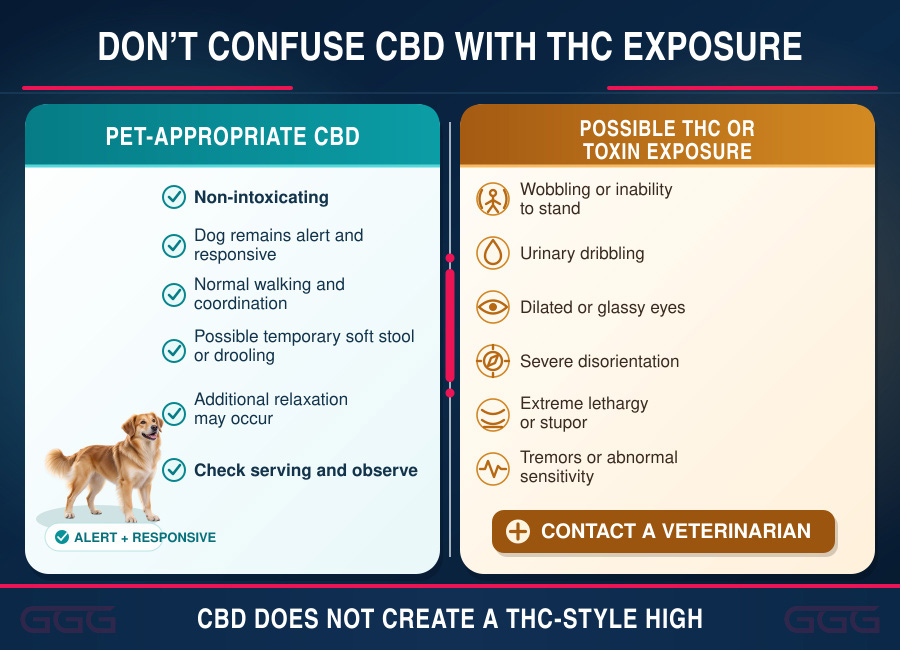
One of the biggest problems with online pet-cannabis information is that CBD and THC are often discussed as though they produce the same effects.
They do not.
CBD is non-intoxicating. THC is intoxicating, and dogs are highly sensitive to it.
Signs More Consistent With THC Exposure Include:
- wobbling or difficulty standing,
- urinary dribbling or incontinence,
- dilated or glassy-looking eyes,
- extreme lethargy,
- unusual sensitivity to sound or touch,
- disorientation,
- stupor,
- tremors,
- and abnormal heart rate or body temperature.
A 2024 review of 223 canine marijuana-toxicosis cases found that acute loss of coordination and heightened sensitivity—with or without urinary incontinence—formed a common clinical presentation.
If a dog displays those signs, owners should not simply assume the dog received “too much CBD” and wait.
Check immediately for access to:
- marijuana flower,
- Delta-8 or Delta-9 gummies,
- brownies or baked edibles,
- vape products,
- discarded cannabis material,
- high-THC oils,
- or another household toxin.
Tell the veterinarian exactly what may have been consumed. That information helps the veterinary team respond faster and more accurately.
Human CBD Products Can Introduce Completely Different Risks
A product containing CBD is not automatically appropriate for a dog.
Human gummies, chocolates, baked products, tinctures, and sleep formulas may contain ingredients that present a much greater concern than CBD itself.
One of the most important is xylitol, a sugar substitute that can cause a rapid insulin surge and dangerously low blood sugar in dogs. Larger exposures can lead to liver failure and bleeding problems.
Human cannabinoid products may also contain:
- meaningful amounts of THC,
- chocolate,
- raisins,
- caffeine,
- sleep ingredients not intended for dogs,
- concentrated essential oils,
- or several active compounds in one formula.
Never give a dog a human gummy simply because the front of the package says “CBD.”
Read the complete ingredient panel and use a product made specifically for pets.
If a dog consumes xylitol or an unknown human edible, contact a veterinarian or animal poison-control service immediately. Do not wait for symptoms to appear.
Could CBD Interact With a Dog’s Medication?
CBD is processed partly through liver-enzyme pathways that also metabolize some medications. That creates a reasonable need for veterinary awareness, particularly when a dog takes:
- antiseizure medications,
- anti-inflammatory drugs,
- sedatives,
- heart medications,
- chemotherapy,
- or several prescriptions together.
However, “possible interaction” should not automatically be translated into “CBD is dangerous with medication.”
In a controlled study of CBD and phenobarbital in healthy dogs, researchers found no significant pharmacokinetic interaction between the two. Much of the broader canine interaction picture is still being studied.
The sensible approach is simple: if a dog takes an important prescription medication, let the veterinarian know about every supplement being used. That allows the veterinary team to consider the complete routine and determine whether bloodwork or timing adjustments make sense.
Why Product Quality Changes the Entire Conversation

When owners report a problem after using a “CBD product,” the active CBD may not be the cause.
The real issue may be:
- inaccurate potency,
- undeclared THC,
- inconsistent mixing,
- unsuitable ingredients,
- contamination,
- an excessive serving,
- poor storage,
- or a product never designed for animals.
A trustworthy pet CBD product should provide:
Clear Milligrams Per Serving
Owners need to know the amount their dog receives—not simply the total amount printed on the front of the jar.
Doggy Be Good™ Original Treats contain 700 mg per jar and 10 mg per labeled half-treat serving.
Pet-Specific Ingredients
A canine product should be designed around ingredients and formats appropriate for dogs, without dangerous human sweeteners or unnecessary intoxicating cannabinoids.
Independent Laboratory Testing
A Certificate of Analysis should verify cannabinoid potency and provide meaningful information about the tested batch.
Consistency From One Purchase to the Next
Pet owners build routines around products. A serving should not change unpredictably because the manufacturer cannot produce a consistent batch.
A Company With a Real Track Record
Packaging can be copied. Experience cannot.
Triple G Hemp™ has supported dogs and their families since launching the first CBD dog treat in 2013. Our formulas are backed by more than 13 years of direct customer feedback, veterinary relationships, batch experience, and a company that remains available when pet owners have questions.
That history is why Doggy Be Good™ is more than another pet product created after CBD became popular.
It helped create the category.
What Should You Do if Your Dog Seems Different After CBD?
If you notice something unusual, stay calm and gather the facts.
1. Confirm the Exact Product
Check whether the dog received:
- a pet CBD treat,
- CBD oil,
- a human gummy,
- a full-spectrum product,
- or something containing Delta-8 or Delta-9 THC.
2. Confirm the Amount
Determine the milligrams per serving and how many servings may have been consumed.
Do not rely only on the large number printed on the front of the package. That usually describes the entire container.
3. Read Every Ingredient
Look for xylitol, chocolate, caffeine, raisins, THC, medications, or other active ingredients.
4. Consider Other Exposures
Dogs are talented opportunists. Check trash cans, countertops, purses, outdoor areas, medication containers, and other treats.
5. Watch the Complete Dog
A temporary soft stool is different from a dog who cannot stand, repeatedly vomits, appears disoriented, has a seizure, or is difficult to wake.
6. Contact Your Veterinarian When Needed
Call promptly if symptoms are significant, worsening, persistent, or neurologic—or if the dog consumed an unknown product, xylitol, THC, medication, or an unusually large amount.
Bring the package or take clear photographs of the label so the veterinary team can see exactly what was consumed.
Frequently Asked Questions
Is CBD Safe for Dogs?
Current canine studies indicate that properly formulated CBD is generally well tolerated, including during daily use lasting six to nine months.
Product quality, serving amount, the dog’s health, and other medications still matter.
Does CBD Make Dogs Sleepy?
Some owners notice additional relaxation, particularly when a dog was previously uncomfortable or unsettled.
Normal relaxation should not resemble intoxication. Extreme lethargy, wobbling, urinary dribbling, disorientation, or difficulty waking is not an expected response to a properly used CBD pet product.
Can CBD Cause Diarrhea in Dogs?
Soft stool has occurred in some studies, particularly at larger experimental amounts. However, new treat ingredients, carrier oils, food sensitivities, dietary changes, and unrelated stomach upset can produce the same result.
An isolated episode does not automatically prove that CBD was responsible.
Can CBD Damage a Dog’s Liver?
Current canine studies have reported increased ALP activity in some dogs, especially at higher amounts, but those findings have generally occurred without corresponding evidence of clinical liver injury.
An isolated ALP increase is not synonymous with liver damage.
Veterinarians may monitor bloodwork in dogs receiving chronic high amounts or taking medications processed through the liver.
What Happens if a Dog Gets Too Much CBD?
A large amount may increase the chance of temporary stomach upset, drooling, or sleepiness. The appropriate response depends on the dog’s size, the amount consumed, the complete formulation, and whether THC or another unsafe ingredient was present.
Contact a veterinarian if the amount is uncertain, the product was not intended for pets, or the dog displays concerning symptoms.
Can CBD Make a Dog High?
No. CBD is non-intoxicating.
If a dog appears intoxicated, investigate possible THC exposure or another toxin rather than assuming this is a normal CBD effect.
Can Dogs Take CBD Every Day?
Research has followed healthy dogs receiving CBD daily for six months and 36 weeks, with generally favorable tolerability.
For a complete explanation, read Can Dogs Take CBD Every Day? Safety, Routine & Long-Term Use.
Should Dogs Use Human CBD Gummies?
No human gummy should be given to a dog without verifying every active and inactive ingredient.
Human products may contain THC, xylitol, chocolate, caffeine, or other components that are inappropriate or dangerous for dogs. Pet-specific products eliminate much of that avoidable uncertainty.
Why Have Doggy Be Good™ Customers Reported So Few Problems?
A measured serving, dog-specific format, reliable manufacturing, batch testing, and more than 13 years of product refinement create a very different experience from an unknown marketplace formula.
Across thousands—and likely tens of thousands—of dogs, we have not identified a recurring CBD side-effect pattern connected to our treats. That real-world history closely matches the strong tolerability reported in controlled canine studies.
Final Thoughts
The phrase “CBD side effects in dogs” sounds more alarming than the evidence warrants.
The honest conclusion is not that an individual dog could never respond differently to a new treat, oil, food, supplement, or medication. Biology does not offer that kind of universal promise.
The evidence does show that:
- CBD is generally well tolerated by dogs,
- serious CBD-attributable adverse effects have been rare in canine research,
- mild observations occur more often at unusually large experimental amounts,
- an isolated ALP increase is not the same as liver damage,
- and many frightening “cannabis” symptoms actually point toward THC or another unsafe ingredient.
That conclusion is also consistent with what Triple G Hemp™ has witnessed since creating the first CBD dog treat in 2013.
For more than 13 years, Doggy Be Good™ has helped families build simple, dependable wellness routines for the animals they love. Our veterinary relationships, measured formulas, customer feedback, and longevity give pet owners something an overnight brand cannot provide:
A product history they can trust.
Choose a pet-specific formula. Read the complete label. Use a measured serving. Pay attention to your dog—not a recycled internet warning list.
Because responsible education should create confidence, not fear.