

CBD for Cats: Benefits, Safety, Dosage & What Cat Owners Should Know
Cats are famously good at hiding discomfort. Subtle changes in jumping, grooming, appetite, sleep, or social behavior may be the first indication that something is affecting their quality of life.
That has led many cat owners to explore cannabidiol, better known as CBD, as part of their cat’s wellness routine. But cats are not small dogs, and giving CBD to a cat requires careful product selection, accurate measurement, and guidance from a veterinarian.
So, can cats take CBD safely—and what should owners know before trying it?
In this guide, we’ll examine:
- how CBD interacts with a cat’s endocannabinoid system
- the potential benefits being explored for feline wellness
- CBD dosage and safety considerations for cats
- how to measure CBD oil accurately using a graduated pipette
- possible side effects and medication interactions
- and what to look for when choosing a quality CBD oil.
This guide is part of our CBD for Pets series, where we explore responsible cannabinoid use, dosage, safety, and everyday wellness for dogs and cats.
👉 Explore more pet and CBD guides: Can Dogs Take CBD Every Day? Safety, Routine & Long-Term Use, CBD Dog Dosage by Weight Chart, Full Spectrum vs Broad Spectrum vs CBD Isolate, and How Long Does CBD Take to Work?.
CBD should be considered one carefully chosen part of a complete feline wellness plan—not a substitute for veterinary diagnosis or treatment.
Can Cats Take CBD?
Cats can consume appropriately formulated CBD products, but research into feline CBD use is still developing. CBD has not been approved by the FDA as a treatment for medical conditions in cats, and there is no universal veterinary dosage that works for every animal.
Early feline studies have nevertheless provided useful information about CBD absorption and tolerability.
One study involving healthy cats found that single oral CBD doses were generally well tolerated within the study population. Other research has evaluated repeated administration and found that cats process CBD differently from dogs, reinforcing the importance of feline-specific guidance rather than simply copying a dog’s routine.
The American Veterinary Medical Association notes that cannabis-derived products suggested for animals have not followed the conventional FDA drug-approval process. Cat owners should therefore discuss CBD with a veterinarian who understands their animal’s health, medications, weight, and individual needs.
CBD should be considered a wellness supplement—not a substitute for veterinary diagnosis or treatment.
How Does CBD Work in Cats?
Like humans and dogs, cats possess an endocannabinoid system, commonly called the ECS.
The ECS is a network of receptors, enzymes, and naturally produced compounds involved in regulating processes such as:
- Mood and stress responses
- Sleep and daily rhythms
- Appetite
- Immune signaling
- Discomfort perception
- Movement and physical function
- Overall internal balance
CBD does not produce an intoxicating “high.” Instead, researchers believe it influences the endocannabinoid system indirectly and interacts with several additional signaling pathways throughout the body.
However, identifying a biological mechanism is not the same as proving that CBD treats a particular feline condition. Much of the condition-specific evidence available for pets remains preliminary, with considerably more research conducted in dogs than in cats.
Potential Benefits of CBD for Cats
Cat owners most commonly explore CBD for calm behavior, physical comfort, mobility, and general wellness. Evidence supporting these uses in cats is still limited, so the potential benefits should be discussed without overstating what research has established.
Supporting Calm During Stressful Situations
Cats can experience stress during travel, thunderstorms, household changes, veterinary visits, boarding, or the introduction of another animal.
Some owners use CBD as part of a broader calming routine that may also include:
- A predictable daily schedule
- Quiet hiding areas
- Familiar bedding
- Environmental enrichment
- Pheromone products
- Gradual exposure to stressful situations
CBD should not be used to conceal severe or sudden behavioral changes. Increased hiding, aggression, vocalization, or inappropriate elimination can indicate pain or illness and should be evaluated by a veterinarian.
Supporting Mobility and Physical Comfort
Older cats may become less willing to jump, climb stairs, groom difficult-to-reach areas, or play as actively as they once did. Because cats often conceal discomfort, these changes can be easy to mistake for normal aging.
CBD is sometimes incorporated into a veterinarian-supervised wellness plan intended to support comfort and quality of life. It does not replace proper evaluation, weight management, environmental modifications, or veterinary treatment.
Adding ramps, steps, lower-sided litter boxes, and accessible resting areas may also make everyday life easier for aging cats.
Supporting Everyday Wellness
Some cat owners use CBD consistently rather than only during an isolated event. The goal may be to support a stable routine, comfortable rest, and general wellbeing.
Consistency can make it easier to observe how a cat responds, but owners should keep expectations realistic. CBD is not a cure-all, and any benefit may be subtle.
CBD Dosage for Cats: How Much Should You Give?
There is currently no universally accepted CBD dosage chart for cats. The appropriate amount can be influenced by:
- Body weight
- Age
- Overall health
- Liver and kidney function
- Medications or supplements
- Product concentration
- Reason for use
- Individual sensitivity
Published feline studies have examined amounts based on milligrams of CBD per kilogram of body weight, but research doses should not automatically be treated as at-home recommendations. A veterinarian should help determine an appropriate starting amount and monitoring plan for an individual cat.
The safest general principle is:
Begin with the lowest veterinarian-recommended amount, measure it accurately, and monitor the cat before making any adjustment.
Never increase the amount simply because an immediate effect is not obvious.
Understanding CBD Oil Concentration and Pipette Measurements
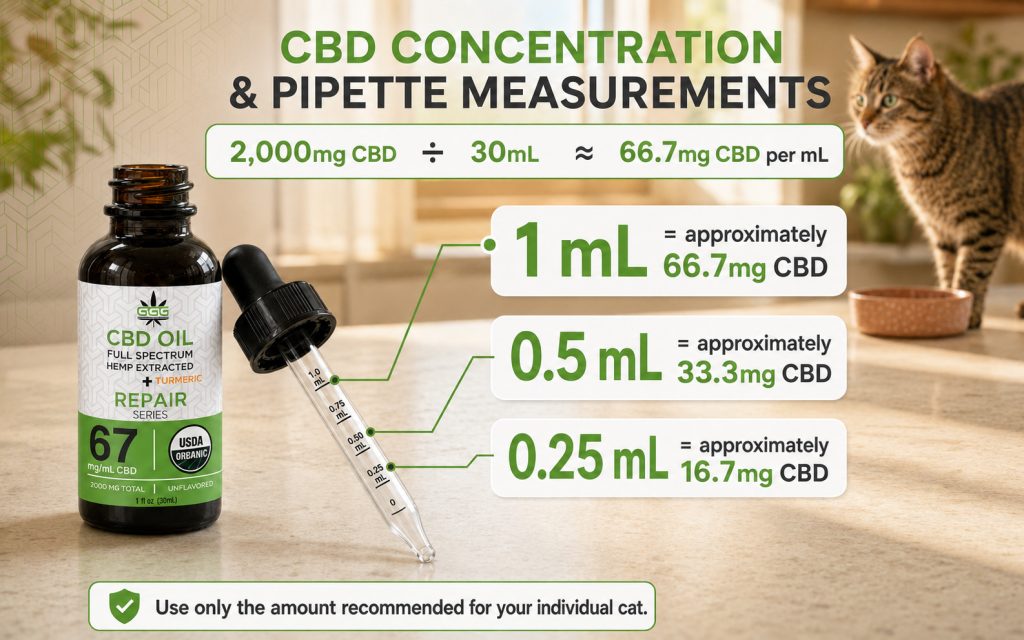
The number printed on a CBD bottle represents the total CBD in the entire container—not the amount in every dropper.
For example, a 2,000mg CBD oil in a 30 mL bottle contains approximately:
- 66.7mg of CBD per 1 mL
- 33.3mg per 0.5 mL
- 16.7mg per 0.25 mL
That does not mean 0.25 mL is automatically the correct amount for every cat. It simply demonstrates why concentration and accurate measurement matter. Depending on a veterinarian’s recommendation, a smaller cat or a particularly sensitive animal may require substantially less.
Triple G Hemp™ CBD oils include a graduated pipette, allowing an owner to see the liquid measurement and measure portions below a full 1 mL dropper. This is much more dependable than trying to count individual drops, which can vary in size depending on the dropper angle, oil temperature, and pressure applied.
Because cats typically use much smaller amounts than adult humans, a properly stored bottle of CBD oil may also last a considerable amount of time.
Always calculate the CBD in milligrams—not merely “drops” or “droppers”—before giving an oil to an animal.
How to Give CBD Oil to a Cat
Anyone who has tried to give a cat an unfamiliar supplement knows that cooperation is never guaranteed.
Add It to Food
For many owners, the simplest approach is to mix the measured oil into a small portion of wet food. Offering a small portion first helps ensure the cat consumes the entire measured amount rather than leaving some behind in a full bowl.
Once that portion has been eaten, the remainder of the meal can be served normally.
Mix It Into a Favorite Treat
A measured amount may also be mixed into a small quantity of a veterinarian-approved lickable treat. This can help mask the unfamiliar texture while keeping the serving concentrated enough to confirm that it was consumed.
Administer It Directly
Some cats tolerate liquid placed carefully into the side of the mouth. Others find direct administration stressful, making food the more practical choice.
Never force liquid toward the back of a cat’s throat, as improper administration can create an aspiration risk. Ask a veterinarian to demonstrate the safest technique if direct administration is necessary.
How Long Does CBD Take to Work in Cats?
There is no single onset time that applies to every cat.
Timing may vary according to:
- Whether CBD was given with food
- The type and size of the meal
- The cat’s metabolism
- Product formulation
- Amount administered
- Whether it is used consistently
- The response being observed
An owner evaluating situational calm may notice changes on a different timeline than someone monitoring general mobility or everyday comfort.
Rather than repeatedly increasing the amount, keep a simple daily record of:
- Time given
- Amount in milligrams and milliliters
- Whether it was given with food
- Activity and mobility
- Appetite
- Sleep
- Behavior
- Any unusual response
That information can help a veterinarian evaluate whether the routine should be continued, adjusted, or discontinued.
Can CBD Cause Side Effects in Cats?
CBD may cause side effects, even when a product is appropriately formulated.
Possible signs to monitor include:
- Excessive sleepiness
- Drooling
- Vomiting or diarrhea
- Changes in appetite
- Unsteady movement
- Behavioral changes
- Increased liver enzyme values
- Sensitivity to other medications
Stop using the product and contact a veterinarian if the cat develops a concerning reaction.
Seek prompt veterinary assistance if a cat consumes a large unintended amount or displays severe lethargy, loss of coordination, repeated vomiting, agitation, tremors, urinary incontinence, or unusual responsiveness.
CBD Is Not the Same as THC
CBD is non-intoxicating, while THC can cause intoxication and potentially serious adverse effects in pets.
Never give a cat recreational cannabis, human THC edibles, or a cannabinoid product containing an unknown amount of THC. Human edibles may also contain chocolate, xylitol, or other ingredients that are unsafe for animals.
Even when selecting a hemp-derived CBD product, examine its laboratory report to verify the cannabinoid profile and confirm exactly what the product contains. A veterinarian may prefer a particular spectrum based on the individual cat and the reason it is being considered.
Talk to Your Veterinarian About Medications
CBD is processed by enzyme systems that also metabolize many medications. This creates the potential for interactions or changes in how another medication is processed.
Veterinary guidance is especially important for cats that:
- Take prescription medication
- Have liver or kidney disease
- Have a seizure disorder
- Are elderly or medically fragile
- Are pregnant or nursing
- Are scheduled for surgery
- Have recently experienced unexplained behavioral changes
Do not discontinue or alter a prescription medication in order to begin CBD.
How to Choose a Quality CBD Oil for Cats
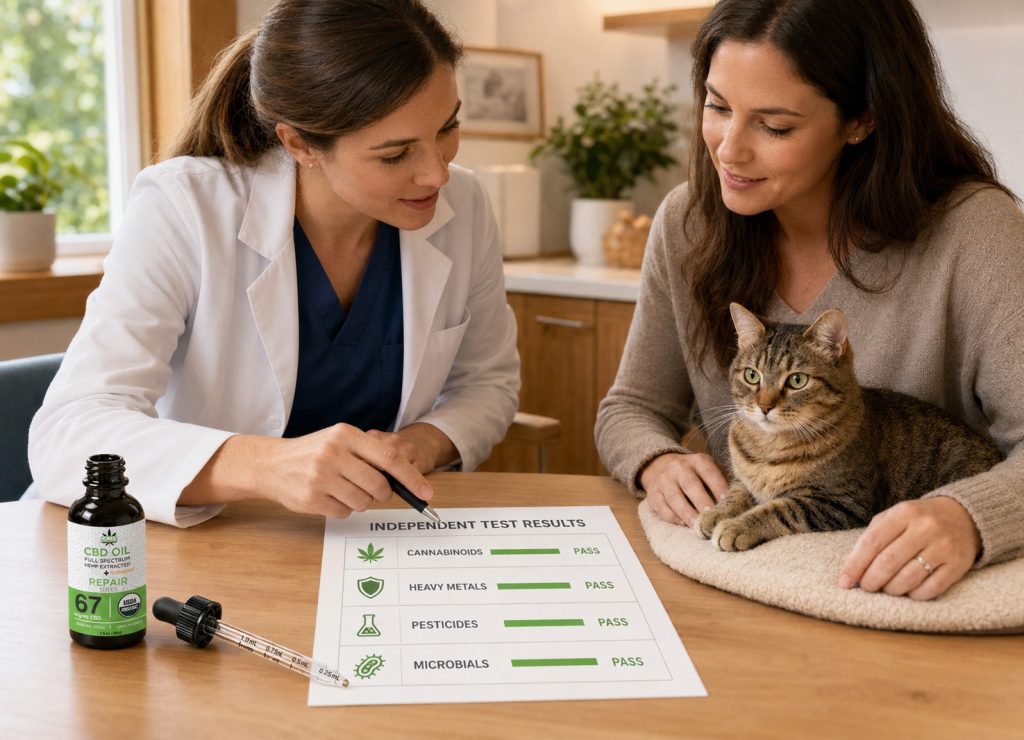
Product quality is particularly important when measuring small servings for an animal.
Look for Independent Laboratory Testing
A current certificate of analysis should verify:
- CBD concentration
- THC concentration
- Cannabinoid profile
- Heavy-metal screening
- Pesticide screening
- Residual-solvent screening
- Microbial safety
The amount measured from the bottle is only useful if the label accurately reflects what the oil contains.
Choose Clearly Labeled Potency
Avoid products that only list “hemp oil” without identifying the actual number of milligrams of CBD. Hemp seed oil and CBD-rich hemp extract are not the same thing.
Review Every Ingredient
A simple formulation is generally easier to evaluate. Avoid products containing unnecessary sweeteners, artificial additives, or essential oils that may be inappropriate for cats.
“Natural” does not automatically mean feline-safe.
Use a Graduated Pipette
A marked pipette makes it possible to measure the oil by volume and calculate the corresponding milligrams of CBD. This is especially valuable when the intended portion is much smaller than a full dropper.
Consider Freshness and Storage
Keep CBD oil tightly closed and store it according to label directions, away from excessive heat, moisture, and direct sunlight. Check the expiration date before use—particularly when one bottle lasts a cat for an extended period.
Frequently Asked Questions About CBD for Cats
Will CBD Make My Cat High?
CBD itself is non-intoxicating. However, THC can cause intoxication and adverse effects in cats, which is why owners should verify the complete cannabinoid profile through current laboratory testing.
Can I Give My Cat Human CBD Oil?
A CBD oil is not automatically safe for a cat merely because a human can use it. Concentration, THC content, carrier oil, flavorings, sweeteners, botanical additives, and medications must all be considered.
A straightforward, accurately labeled CBD oil may be easier for a veterinarian to evaluate, but owners should obtain professional guidance before giving it to their cat.
Can I Give CBD to My Cat Every Day?
Some feline safety research has examined repeated CBD administration, but that does not establish one daily routine for every cat. Daily use should be discussed with a veterinarian, particularly for cats taking medications or managing chronic health concerns.
Is CBD Oil or a CBD Treat Better for Cats?
CBD oil provides more control over the amount administered because it can be measured in small increments using a graduated pipette. Treats contain a fixed amount and may be difficult to divide accurately.
Oil is also easier to mix into wet food, which can be helpful for cats that reject unfamiliar treats.
What Should I Do If My Cat Refuses Food Containing CBD?
Do not allow a cat to skip necessary meals in an attempt to make it consume CBD. Try placing the measured oil into a much smaller portion of food or a veterinarian-approved lickable treat. If the cat continues refusing it, stop and ask your veterinarian about another approach.
Final Thoughts: Should You Give Your Cat CBD?
CBD is attracting interest as a potential way to support calm behavior, mobility, physical comfort, and everyday wellness in cats. Early safety and pharmacokinetic research is encouraging, but feline evidence remains limited and CBD is not an FDA-approved treatment for medical conditions in cats.
The responsible approach is to:
- Speak with a veterinarian first
- Choose an accurately labeled, independently tested oil
- Review every ingredient
- Calculate the amount in milligrams
- Measure it with a graduated pipette
- Begin only with the amount recommended for the individual cat
- Monitor behavior, appetite, coordination, and overall wellbeing
Cats deserve more than a scaled-down dog routine. Their smaller size, unique metabolism, and ability to conceal illness make careful measurement and veterinary oversight especially important.
When CBD is used, it should be one thoughtfully chosen part of a complete feline wellness plan—not a replacement for professional care.