
CBG has spent years in CBD’s shadow. Now, new research is giving the “mother cannabinoid” a more specific scientific storyline—one involving immune signaling, neutrophils, inflamed joint tissue, and experimental models of arthritis.
The latest findings are interesting. They are also preclinical. That distinction is the difference between responsible cannabinoid education and a medical claim.
A 2026 study found that purified cannabigerol, or CBG, reduced several inflammatory signals in human neutrophils studied outside the body and improved disease measures in a mouse model of rheumatoid arthritis. Earlier work has reported anti-inflammatory activity in cells taken from people with rheumatoid arthritis and joint-protective signals in a mouse model of osteoarthritis. But we still do not have large human trials showing that over-the-counter CBG treats arthritis, repairs cartilage, or reliably relieves joint pain.
| THE SHORT ANSWER CBG has credible anti-inflammatory and joint-health signals in laboratory and animal research. Human evidence remains limited, and no CBG retail product is FDA-approved to treat rheumatoid arthritis, osteoarthritis, inflammation, or pain. |
In this guide, we’ll explain:
- What inflammation does—and why not all joint discomfort has the same cause
- How CBG interacts with cannabinoid and TRP signaling systems
- What the important new 2026 rheumatoid-arthritis study actually tested
- What earlier rheumatoid-arthritis and osteoarthritis research found
- How much direct human evidence exists today
- How to evaluate CBG products without turning early science into a promise
What Is CBG?
Cannabigerol is a naturally occurring cannabinoid found in cannabis and hemp. The plant first produces cannabigerolic acid, or CBGA, which serves as a precursor used to form several other cannabinoid acids. That is why CBG is often called the “mother cannabinoid.”
Like CBD, CBG is generally described as non-intoxicating—it does not produce the classic high associated with delta-9 THC. Non-intoxicating does not mean biologically inactive. CBG interacts with multiple targets involved in sensation, immune signaling, stress response, and the nervous system, including cannabinoid receptors, alpha-2 adrenergic receptors, and members of the transient receptor potential, or TRP, family.
For a broad comparison, see CBG vs CBD: Which Is Better for Daytime Focus?.
Inflammation and Joint Health Are Related—but Not Identical
Inflammation is part of the body’s defense and repair system. In the short term, it helps respond to injury or infection. Trouble begins when inflammatory signaling is excessive, misdirected, or persistent.
Joint symptoms can arise from very different processes. Rheumatoid arthritis is an autoimmune disease in which immune activity drives inflammation in the joint lining and can damage tissue. Osteoarthritis involves cartilage breakdown and changes across the entire joint; inflammation can contribute, but it is not the same disease process. Muscle soreness after exercise is different again.
That matters when reading cannabinoid headlines. A compound that changes a cytokine in a cell dish has not automatically been shown to relieve osteoarthritis pain. A result in an autoimmune mouse model does not prove the same result in a person. “Anti-inflammatory” is a laboratory description until human trials connect the mechanism to a meaningful clinical outcome.
How Might CBG Affect Inflammatory Signaling?
CBG does not appear to act through one master switch. Reviews describe activity across CB1 and CB2 cannabinoid receptors, TRP channels such as TRPA1, and other targets. These systems can influence the release of signaling molecules, immune-cell movement, pain perception, and tissue responses.
CB2 is especially interesting in immune research because it is expressed on many immune cells. TRPA1 is involved in sensory signaling and cellular responses to oxidative stress. Laboratory findings suggest CBG can change cytokine production and inflammatory pathways under certain experimental conditions.
Mechanistic plausibility is useful—it helps scientists decide what to test next. But the human body is more complex than an isolated receptor or cultured cell. Absorption, metabolism, dose, formulation, target tissue, and long-term safety all determine whether a laboratory signal becomes a useful therapy.
A 2024 comprehensive review maps these mechanisms and repeatedly notes the limited human evidence. Read the review.
The New 2026 Study: CBG, Neutrophils, and Rheumatoid Arthritis

The most important new study focused on neutrophils—fast-moving immune cells that help fight infection but can also contribute to rheumatoid-arthritis inflammation and tissue damage.
Researchers used two different levels of evidence. First, they isolated neutrophils from human blood and studied them ex vivo, meaning outside the body. Second, they tested CBG in mice with antibody-induced arthritis.
What happened in the human-cell experiments?
Under the study’s laboratory conditions, CBG reduced secretion of the pro-inflammatory cytokines TNF-alpha and IL-6, downregulated several inflammatory signaling pathways, and reduced neutrophil migration toward an inflammatory signal. Some of the IL-6 effect was linked to CB2-receptor signaling.
What happened in mice?
In the arthritis model, CBG improved clinical disease scores, reduced immune-cell recruitment into inflamed joints, and lowered several inflammatory signals in blood or joint tissue. These findings give researchers a coherent biological story: CBG influenced both the chemical messages and the movement of immune cells involved in the model.
What the study did not prove
It did not enroll people with rheumatoid arthritis. It did not test an over-the-counter CBG capsule or oil. It did not establish a human serving, compare CBG with standard arthritis medications, or show long-term safety. The authors themselves concluded that the findings were preclinical and needed validation before therapeutic positioning.
That final sentence belongs in every responsible summary of the research. Read the 2026 study.
The percentages reported in a laboratory experiment describe that experiment. They should not be converted into claims such as “CBG reduces human inflammation by 72%.”
Earlier Rheumatoid-Arthritis Cell Research
A 2023 study examined CBG in rheumatoid-arthritis synovial fibroblasts—cells from the tissue lining affected joints—and in cultures containing peripheral blood immune cells. CBG changed calcium signaling, reduced cell viability under some conditions, and altered production of inflammatory cytokines and antibodies. Some, but not all, effects appeared to involve TRPA1.
This study strengthened the case that CBG can act on several pathways relevant to rheumatoid arthritis. It also showed why simple receptor explanations are incomplete. Biological effects depended on the cell type, activation stimulus, concentration, and whether cells were studied alone or together.
Read the 2023 rheumatoid-arthritis cell study.
What About Osteoarthritis and Cartilage?
Rheumatoid arthritis and osteoarthritis should never be merged into one headline. Still, CBG has been studied in an osteoarthritis model too.
In a 2023 mouse study, topical oils containing CBD or CBG reduced synovitis, a form of inflammation in the joint lining. In that experiment, the CBG formulation also reduced cartilage degeneration and chondrocyte loss. That is a compelling preclinical signal because cartilage preservation is a harder outcome than a short-term change in soreness.
Yet it remains a mouse study using a specific experimental formulation. It does not establish that a retail oral capsule or topical will protect human cartilage. Differences in skin, metabolism, joint disease, formulation, and exposure all matter.
Review the osteoarthritis animal study.
Do We Have Human Evidence for CBG and Pain?
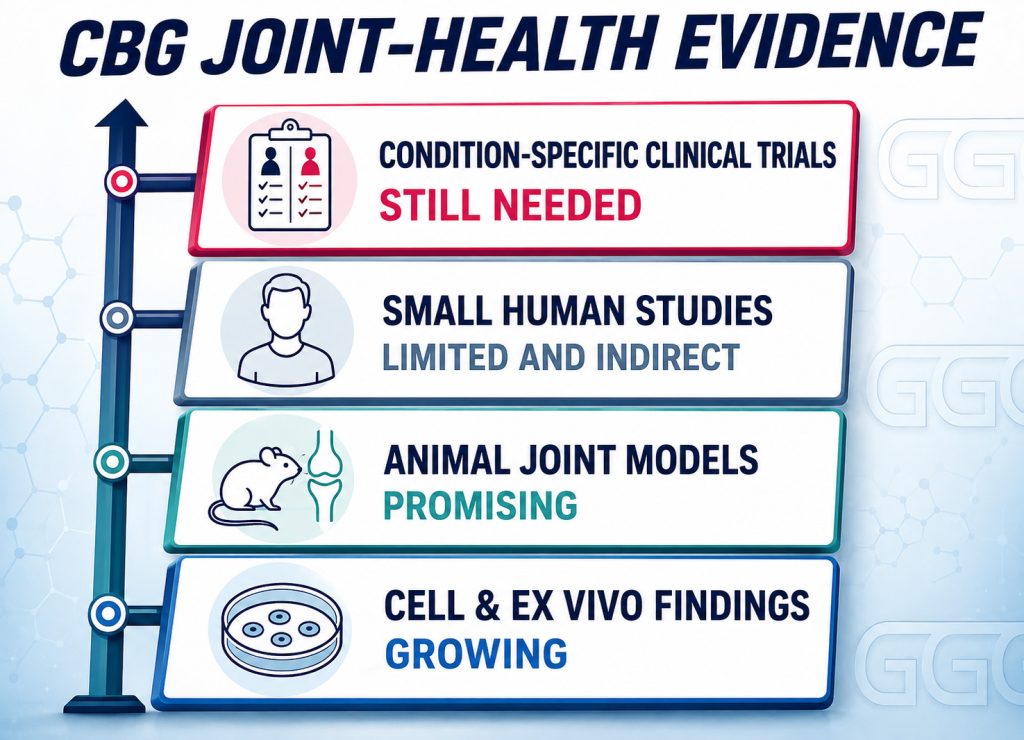
Direct human evidence is the weakest part of the CBG joint-health story.
A randomized study of a CBG-based beverage powder found less interference from delayed-onset muscle soreness in daily activities. That is useful early evidence, but exercise soreness is not rheumatoid arthritis, osteoarthritis, or chronic joint pain. The product was a specific formulation, and the outcome does not tell us that CBG changes joint disease.
A separate 2024 double-blind trial gave healthy adults 20 mg of hemp-derived CBG and reported no subjective intoxication or impairment. It also explored anxiety, stress, and memory. That study helps build a human tolerability picture for one amount and one setting, but it was not a pain or arthritis trial.
Read the delayed-onset muscle soreness study and the 2024 human CBG trial.
The missing study is straightforward: a sufficiently large, well-controlled human trial using a chemically characterized CBG product in people with a defined joint condition, with pain, function, sleep, quality of life, inflammatory markers, adverse events, and medication interactions tracked over time.
CBG vs CBD for Inflammation and Joint Wellness
CBD has a larger research footprint than CBG, but that does not automatically make CBD better—or make CBG’s smaller evidence base stronger than it is. The cannabinoids interact with overlapping and distinct targets, and studies often use different formulations, routes, and outcomes.
Some consumers prefer CBG for daytime routines because they describe it as clearer or less settling than CBD. Others prefer CBD or a balanced CBD:CBG product. Those are individual experiences, not established treatment rankings.
Combination products introduce another layer: if someone feels different after taking CBD and CBG together, the response cannot be assigned to CBG alone. Researchers must test the actual formulation people use.
Learn more in Can You Take CBD and CBG Together?.
Choosing a CBG Format Without Overpromising

Capsules
Capsules provide a fixed amount and are easy to repeat consistently. GGG™ CBG Capsules contain 50 mg of CBG per capsule and are available in 30- and 60-count bottles. That precision is useful for label literacy and routine tracking; it is not a disease-treatment claim, and 50 mg should not be interpreted as a clinically established arthritis dose.
View GGG™ CBG Capsules.
Oils
Oils allow more flexible measurement when the dropper is clearly marked and the concentration is stated in milligrams per milliliter. A balanced CBD:CBG oil may suit someone exploring both cannabinoids, but any result belongs to the whole formulation—not CBG alone.
Topicals
Topicals are applied to a localized area, but absorption and formulation vary widely. Cooling or warming ingredients, massage, and the base itself can affect how a topical feels. A pleasant sensation does not establish that CBG entered the joint or changed the underlying disease.
For a practical format comparison, see CBG Gummies vs CBG Capsules.
How to Evaluate Product Quality
- Find a batch-specific certificate of analysis that confirms CBG potency and the amounts of CBD, THC, and other cannabinoids.
- Check contaminant testing for pesticides, heavy metals, residual solvents, and microbes—not potency alone.
- Read the concentration in usable units. “1,500 mg per bottle” is incomplete without capsule count or milligrams per milliliter.
- Prefer transparent formulations over proprietary blends that hide cannabinoid amounts.
- Treat dramatic arthritis, cartilage-regrowth, or pain-cure claims as warning signs.
- Keep a simple symptom and routine log so expectations do not replace observation.
Safety and Medication Considerations
Human safety data for CBG remain limited, particularly for long-term daily use, higher exposures, older adults, pregnancy, breastfeeding, and people taking multiple medications. “Non-intoxicating” is not the same as universally safe.
Talk with a clinician or pharmacist before adding CBG if you use prescription drugs, especially medications with a narrow therapeutic range or drugs that affect blood pressure, alertness, the liver, or immune function. Do not stop anti-rheumatic, pain, or other prescribed medication because of a cannabinoid article or product.
Avoid driving or safety-sensitive work until you know your response. Stop and seek medical advice for concerning reactions. Products should be secured away from children and pets, and use during pregnancy or breastfeeding should be avoided unless a qualified clinician specifically directs otherwise.
Frequently Asked Questions
Is CBG good for inflammation?
Laboratory and animal research shows anti-inflammatory activity under specific conditions. Human trials have not yet established CBG as an effective treatment for inflammation or inflammatory disease.
Can CBG treat rheumatoid arthritis?
No such claim is supported today. The new 2026 study used human immune cells outside the body and a mouse arthritis model. It did not test CBG treatment in people with rheumatoid arthritis.
Can CBG rebuild cartilage?
A mouse osteoarthritis study reported less cartilage degeneration with a CBG formulation, but that does not prove cartilage repair or protection in humans.
Does CBG make you high?
CBG is generally considered non-intoxicating. A small 2024 human trial did not find subjective intoxication or impairment after 20 mg, but individual products and responses vary.
Is there a proven CBG dose for joint pain?
No. There is no FDA-approved or clinically established retail CBG dose for joint pain, rheumatoid arthritis, or osteoarthritis.
The Bottom Line
CBG’s joint-health research has moved beyond a vague “anti-inflammatory” talking point. Scientists now have specific findings involving neutrophil movement, cytokine signaling, rheumatoid synovial cells, synovitis, and cartilage outcomes in experimental models.
That is real progress. It is not yet proof of a human treatment.
The strongest 2026 position is optimistic and precise: CBG has earned more serious clinical research. Until those trials arrive, consumers should treat it as an emerging wellness ingredient, choose transparent products, track their own response, and keep evidence-based medical care at the center of any joint-health plan.