

CBG for Brain Health: What Does the Research Actually Show?
The brain is extraordinarily powerful—and extraordinarily vulnerable.
Brain cells require a constant supply of oxygen and energy while defending themselves against oxidative stress, inflammation, metabolic dysfunction, and the gradual wear associated with aging.
Researchers are now investigating whether cannabigerol, better known as CBG, may influence some of these protective processes.
Often called the “mother cannabinoid,” CBG is non-intoxicating and interacts with several signaling systems involved in inflammation, oxidative balance, mood, and neurological function. Early findings have made it one of the most interesting minor cannabinoids in brain-health research.
But there is an important distinction: promising laboratory findings do not mean CBG has been proven to prevent, repair, or treat neurological disease in humans.
In this guide, we’ll explore:
- how CBG interacts with neurological signaling systems
- what neuroprotection means
- how oxidative stress and neuroinflammation affect brain cells
- what research suggests about cellular defense and repair pathways
- findings from experimental neurodegeneration models
- early human research involving memory and stress
- and how CBG differs from CBD.
This guide is part of our CBG Education & Research Series, where we explore the emerging science behind cannabigerol, its potential benefits, product types, and responsible use.
👉 Explore more CBG guides: What Does CBG Feel Like?, CBG vs CBD: Which One Is Better for Daytime Use?, CBG Dosage Guide, and Can You Take CBD and CBG Together?.
The science is exciting, but understanding its current limitations is essential.
What Is CBG?
CBG is a naturally occurring cannabinoid found in hemp and cannabis.
Young plants initially produce cannabigerolic acid, or CBGA. Enzymes then convert CBGA into the acidic precursors of cannabinoids including CBD and THC. Because so many cannabinoids originate from CBGA, it is frequently called the “mother cannabinoid.”
By the time most plants mature, only a relatively small amount of CBG remains. Specialized genetics and harvesting methods are therefore needed to produce CBG-rich hemp.
Unlike THC, CBG is not considered intoxicating. It does not typically produce the euphoria or perceptual changes associated with a THC high.
That non-intoxicating profile has helped make CBG particularly interesting for daytime wellness, mental clarity, and neurological research.
How CBG Interacts With the Brain and Nervous System
CBG does not act through only one biological pathway.
Research indicates that it may interact with:
- CB1 and CB2 cannabinoid receptors
- Alpha-2 adrenergic receptors
- Serotonin-related signaling
- TRP ion channels
- PPAR receptors involved in metabolism and inflammation
- Anandamide signaling
- Oxidative and inflammatory pathways
This broad activity is one reason scientists are investigating CBG across several neurological models.
CB1 receptors are concentrated throughout the central nervous system, while CB2 receptors are associated more strongly with immune signaling. CBG’s wider interactions may also influence stress responses, discomfort perception, inflammatory activity, and cellular energy regulation.
Researchers have not yet determined how all these mechanisms translate into long-term human outcomes.
What Does “Neuroprotection” Mean?
Neuroprotection refers to processes that help defend neurons and other nervous-system cells against injury, dysfunction, or degeneration.
Potential neuroprotective mechanisms can include:
- Reducing excessive oxidative stress
- Moderating inflammatory signaling
- Supporting mitochondrial function
- Limiting excitotoxic cellular damage
- Supporting normal protein-clearance systems
- Helping maintain the blood-brain barrier
- Promoting cellular survival pathways
Neuroprotection is not the same as regenerating an entire damaged brain region or curing a neurological condition.
When researchers describe CBG as neuroprotective, they are generally referring to effects observed in cells, tissues, or animal models. Those findings help scientists identify possible mechanisms worthy of further study, but they do not establish a proven treatment for people.
CBG, Oxidative Stress and Cellular Defense
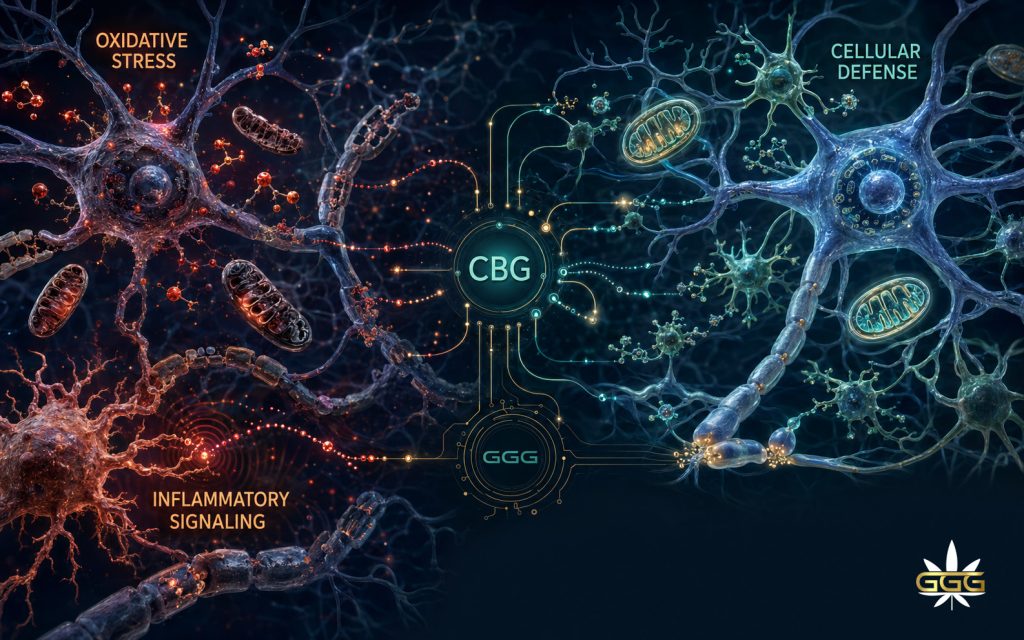
The brain consumes a large amount of oxygen relative to its size. This energy demand makes brain tissue especially sensitive to oxidative stress.
Oxidative stress occurs when reactive molecules overwhelm the body’s antioxidant defenses. Over time, excessive oxidative activity may damage cellular membranes, proteins, mitochondria, and DNA.
Laboratory research suggests CBG may influence antioxidant defense and help protect cells exposed to certain forms of oxidative injury.
This is where the phrase cellular repair requires careful context.
Research does not show that taking a CBG capsule directly rebuilds damaged neurons. Instead, experimental findings suggest CBG may support signaling environments associated with cellular protection, survival, recovery, and the management of oxidative stress.
That remains potentially important. Protecting cells from additional damage can be one component of the broader repair and recovery process, even if the cannabinoid is not literally replacing lost neurons.
CBG and Neuroinflammation
Inflammation is part of the body’s normal defense system. In the brain, immune activity is managed partly by cells called microglia.
Short-term inflammation can help protect tissue following injury or infection. Persistent or poorly regulated neuroinflammation, however, may interfere with normal cellular function and is being investigated across numerous neurological conditions.
Preclinical studies suggest CBG may affect inflammatory mediators and signaling pathways involved in neuroinflammation.
A comprehensive review of CBG research describes potential anti-inflammatory, antioxidant, and neuroprotective mechanisms, while emphasizing that much of the evidence remains preclinical. Read the comprehensive CBG review.
These findings do not prove that CBG treats neuroinflammatory disease. They demonstrate biological activity that warrants more controlled human research.
What Research Says About CBG and Neurodegeneration
Some of the most interesting CBG findings involve experimental models related to neurodegeneration.
A 2026 scientific review examining cannabinoids, the blood-brain barrier, and neurodegeneration discusses CBG’s activity in multiple Huntington’s disease models. Researchers observed effects involving neuronal survival, oxidative stress, inflammatory signaling, and motor-related outcomes in preclinical systems. Review the 2026 neurodegeneration research.
CBG has also been investigated in experimental models involving:
- Huntington’s disease
- Parkinson’s-related cellular injury
- Memory impairment
- Cerebral injury
- Neuroinflammation
- Oxidative neuronal stress
These are laboratory and animal findings—not clinical evidence that CBG prevents or treats these conditions in humans.
CBG products should never be presented as replacements for neurological evaluation, medication, rehabilitation, or established medical care.
Can CBG Support Memory and Focus?
Many consumers describe CBG as clear-headed, alerting, or useful during the daytime. Until recently, most evidence behind those descriptions came from preclinical research and consumer reports.
A small 2024 double-blind, placebo-controlled study involving 34 healthy adults examined a single 20mg amount of hemp-derived CBG.
Compared with placebo, researchers reported reductions in anxiety and stress along with improved performance on a verbal-memory test. Participants did not show evidence of intoxication or impairment. Read the human CBG study.
The results are intriguing, but one small study cannot establish that CBG reliably improves memory or cognitive performance. Larger trials involving different populations, amounts, formulations, and longer observation periods are necessary.
It is nevertheless one of the first controlled human studies to move CBG research beyond cells and animal models.
CBG vs CBD for Brain Health
CBD and CBG are both non-intoxicating cannabinoids, but they interact with the body differently.
CBD has a larger overall research base and is often discussed in relation to calm, neurological balance, and neuroprotection. CBG research is considerably younger but has attracted attention for its interaction with inflammatory, oxidative, adrenergic, and cellular-survival pathways.
A simplified comparison looks like this:
| CBD | CBG |
|---|---|
| Much larger research base | Earlier and more limited research |
| Often associated with calm and balance | Often described as clear-headed or daytime-friendly |
| Broad indirect influence on the ECS | Interacts with several receptors and signaling targets |
| Studied extensively for neurological applications | Promising preclinical neuroprotective research |
| May feel relaxing for some users | May feel more alerting for some users |
This does not mean CBD only protects while CBG “repairs.” Biology is much more complex.
Both cannabinoids are being investigated for overlapping antioxidant, anti-inflammatory, and neuroprotective actions. The important difference is the exact signaling pathways they influence and the amount of evidence available for each.
Some consumers prefer CBG alone, while others use a balanced CBD-and-CBG formulation such as a one-to-one oil.
How Much CBG Should You Take?
There is no clinically established CBG amount for brain health, neuroprotection, or neurological disease.
The appropriate serving can vary according to:
- Product formulation
- Body weight and metabolism
- Cannabinoid experience
- Sensitivity
- Medications
- Reason for use
- Whether CBD is taken alongside it
Someone new to CBG should begin conservatively and avoid assuming that an amount used in one study is an individualized recommendation.
Triple G Hemp™ CBG Capsules contain 50mg of CBG per capsule, providing a measured and repeatable serving for experienced consumers who prefer capsules. The One2One™ CBD/CBG Oil provides a balanced alternative for consumers who want both cannabinoids and greater flexibility in measuring the amount used.
Consult a healthcare professional before using CBG if you take medication, manage a medical condition, are pregnant or nursing, or are preparing for surgery.
Choosing a Quality CBG Product
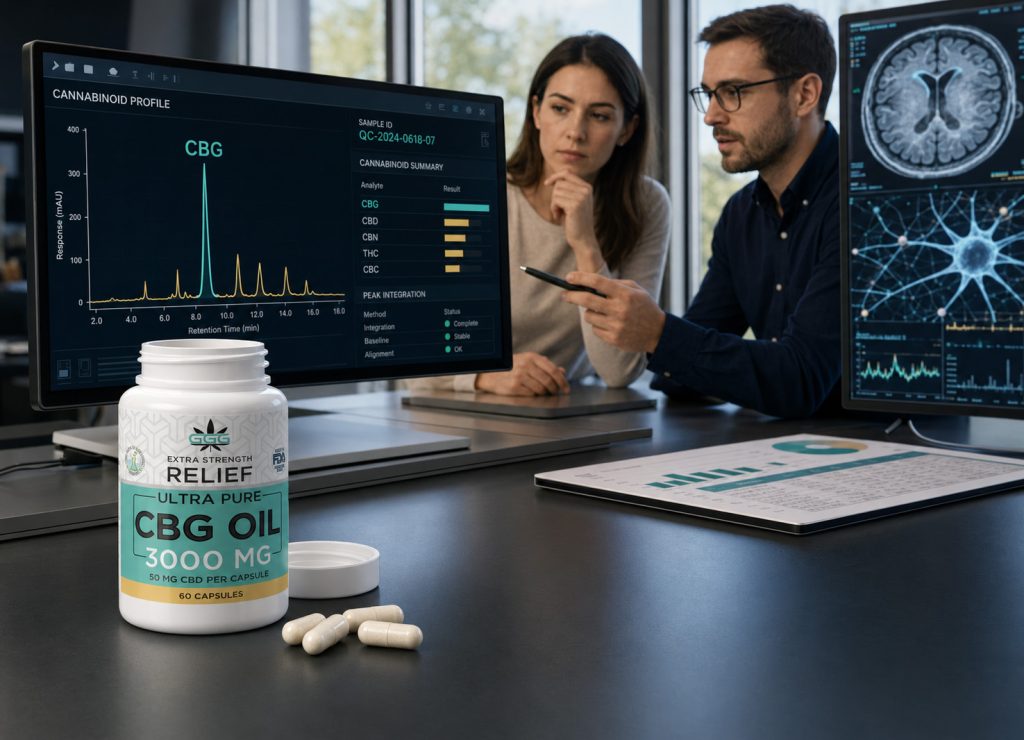
Minor-cannabinoid products require the same quality controls as CBD and THC products.
Look for:
- Clearly stated CBG per serving
- Independent laboratory testing
- Cannabinoid potency verification
- Heavy-metal screening
- Pesticide screening
- Residual-solvent testing
- Microbial safety results
- Transparent ingredient labeling
- Reliable batch and expiration information
A product cannot meaningfully support a consistent wellness routine if the amount inside each capsule or serving does not match its label.
Consumers should also be cautious of products claiming to cure Alzheimer’s disease, Parkinson’s disease, Huntington’s disease, or other neurological conditions. Early research does not justify those promises.
Quality begins with accurate formulation, but trust also requires honest communication about what science has—and has not—proven.
Final Thoughts: Is CBG Promising for Brain Health?
CBG is one of the most compelling minor cannabinoids currently being investigated for neurological health.
Preclinical findings suggest potential activity involving:
- Neuroprotection
- Oxidative stress
- Neuroinflammation
- Mitochondrial and cellular function
- Neuronal survival
- Memory-related pathways
- The blood-brain barrier
A small controlled human study has also produced encouraging early findings involving stress, anxiety, and verbal memory.
However, most disease-specific evidence still comes from cells and animals. CBG has not been proven to prevent, reverse, or treat a neurodegenerative disease in humans.
The responsible conclusion is neither “CBG repairs the brain” nor “CBG does nothing.” The truth lies between those extremes:
CBG interacts with several systems relevant to brain-cell protection and recovery, and the early science is promising enough to justify considerably more research.
For consumers, CBG may provide a non-intoxicating addition to a daytime wellness routine. For scientists, it represents a largely unexplored cannabinoid with potentially important neurological applications.
And for both groups, the next several years of CBG research should be extremely interesting.